
16 November 2010
Announcement: The Criterion February Releases!


10 October 2010
18 July 2010
Review: Inception

Christopher Nolan's 2010 feature Inception bears the mark of the film-maker in its commitment to action, fervor, and tension in the narration but ultimately is a completely different type of film-work from that which the director has before given his audience. Though perhaps Inception is laced up front as a tight and intricate psychological construct proper, the underlying romantic cistern slowly swilling its defiantly nectary water verily belies this construct by supplanting its roots in the screenplay under those of the romance's own. And, if any should question this deep and most elemental romance, ballasting the entire work, one need look no further than the conclusive scenes for one's fait accompli answer: The narrative never mattered really, like the top spinning on its delicate axis the narrative was but the ballooned bell lathing itself over and over again on that axis in elegant yet beguiling design.
Mr. Nolan fortunately seems to be aware of this fact and does no unjustice to himself by trying to conceal it beneath casuistry or effrontery against the couple of lovers, played typically by Mr. DiCaprio and Ms. Cotillard; indeed, their abiding indulgence into one another is given its quite comfortable due even amidst the delicately engineered harry of the pinnacle sequence of the film - a sequence so well edited that it alone should stand for an end-of-year award, abashed be all its competitors. (Also particularly strong therein were Mr. Pfister's cinematography, especially in its capturing the suspended movements of Mr. Gordon Levitt in the set hotel, and Mr. Walsh's art direction and Mr. Kurland's costume-designs, which together never once faltered to the extent that I began to doubt in my mind the suspensive belief that each concentric sphere of simulated reality in the plot of the film would and could be for some characters, involved both inside and outside the screen, true.)
However, ultimately the romance that is the greatest part of the pitch on which this film rolls becomes the cliché that detains the film from fully escaping its otherwise impeccably (i. e., distantly) produced quality; savage cliffhangers that bluntly compel the viewer to question the finality of the narrative are adolescent filmmaking's stratagems, usually reserved by the studios for those films that have the potential to be or that already are set to become franchises/series, each part of which needs the springboard of its predecessor. And, like there was for Brazil (1985), I'm wondering, is this unclosed and potentially springboard ending the honest ending of the film or the studio's turgid recommendation for ultimate pizzazz? Only Mr. Nolan knows for sure, I suppose.
In any case, his screenplay was not without flaws outside this tacky ending. At the other end of the arc, the play suffers from the trouble that must plague every writer of an apud mundum alienum set film: How may I as a writer explain the premises and rules of my alien world to my audience as comprehensively yet unobtrusively as possible? In answer, a good and common tactic is to introduce as a necessary part of the cast a character who himself or herself is a novitiate into the alien world, so that by his or her learning its ways and wonders the audience may learn them too - and, in truth, Mr. Nolan does utilize this tactic well to a degree in his Inception, through the introduction and play of Ms. Page's character, the young and scrupulous architect Ariadne (obviously not unconsciously named in a nod to the Ariadne of Classical myths). However, despite Ariadne's for the audience vicarious induction into the world of active dreaming that places Inception - or perhaps due to the relative lateness of this induction in the film's arc - Mr. Nolan troublingly still falters, opening the story with bald statements and declarations of the governing rules and principles of its dreaming-setting (assumedly lest his audience miss these core connections). These awkward declarations not only make for bad screenwriting in a general sense, but also undermine the credibility of his characters as permanent and enduring figures, familiar with the worlds in which they operate as they are familiar to each other, and - moreover - the credibility of a guiding premise of this particular screenplay itself: the premise that it is unimportant to the experiencer the means or method by which he or she has arrived at where and when he or she is here and now, that it is important to the experiencer only that where and when he or she is here and now is here and now and that a plot may from here and now continue un-broken or un-upset into the future. In short, by breaking the screenwriter's fourth wall and explicitly telling the audience the rules of his game, Mr. Nolan is not only giving in to sloppy and weak film-making but also and moreover letting go especially sloppy and weak this-film--making, because this film of all films relies on and takes pride in jettisoning out its characters into forays entirely en train de mise-en-scène. Straying from this premise, even if for the audience's confidence, is a high inconsistency in the crafting of this film.
Yet, this inconsistency is not the only inconsistency in the film's crafting. Another almost equally prominent inconsistency is visual, in that the mise-en-scène particularly in the dream scenes is oftentimes incoherently rigid: literal and physical. The film-makers, Mr. Nolan and Mr. Pfister primary here among them, seem strainingly unwilling to diverge from their ties of the conventions of filmic story-telling and indulge themselves - as they could have and should have - into the techniques and trappings of fantasy (i. e., by bending the realities of their images as they have bent and do bend the realities of those images' worlds). Indeed, aside from the few still physical (i. e., optical) special effects that the film carries, the film - excluding its pinnacle sequence's managing the zero-gravity environment - is almost entirely devoid of any permutation, quavering, or bending that one may expect from a film immersed in dream-fluid. Inception is radically different from your previous works (e. g., The Dark Knight, 2008; The Prestige, 2005; Memento, 2000), Mr. Pfister; it is not of a world tied down and limited by real physics. It was therefore disappointing for me to see you and your director so seldom treat it as such an exception; content-based distortions of reality were not enough; optical distensions and exaggerations, as most incipiently was captured by your slowed imaging of Mr. DiCaprio's early emergence from the water in the bath-tub (, could have added so much to your work.
One final critique, sirs: I was often worried throughout my viewing of the film by the degree to which Mr. Nolan let Mr. Zimmer's thumping score inflate the emotions that his other director's tools (e. g., actors, cameras, words, backgrounds) were there to convey. While I have to be hesitant in my making of this point since I have not seen Inception without its score, I nevertheless feel compelled to cite the director for leaning so heavily on his composer's emotional pounding to do the legwork in communication - for there was little indication that I would have felt as strongly the emotion of the action before me, if there had been no musical enhancements, as I did because there were. At its heart, this dearth of indication is pausing at best in my appreciation of the already evident abilities of the film-makers to perform well behind the lens.
The bottom line for Inception, then, is not that I disliked the work but that I - I believe, rightly - could have liked the work much more. Were it not for the limitations of creative vision that I have identified to be hampering the thorough coherence of the film, I believe, the film could have been an extraordinary addition to the medium's canon. The aptest quote of which I can think to succinctly summarize this jostled appreciation is Cate Blanchett's from Mr. Scorcese's The Aviator (2004), in which Mr. DiCaprio also starred (though to greater success): "You're not extending enough on your follow-through. Follow-through is everything in golf, just like life. Don't'cha find?"
Grade: B+, only partially realized.
P. S. Though I accept the persistence of the usage of the basic tropes of understanding that were excerpted in the 1950s from the "everyman's handbook of psychology" in today's film-making, I have to ask, why are these tropes and their usage still so persistent in today's art? I mean, doesn't anyone read the new psychology today? Ahem, Mr. DiCaprio (Shutter Island), why?
Review: The Kids Are All Right

Let me write plainly here, lest I misstate my primary conviction about directress' Lisa Cholodenko's rompous The Kids Are All Right: Ms. Bening is flawless. Yes, you read that adjective correctly: flawless. Rare be it the time that I bestow upon an actor from my lofty perch of this tiny blog an encomium so whole that I must use terms conveying perfection, now is such a time. Behold, all who may still have a lingering doubt about the aptitude and strength of this actress who has delivered stellar performances before (e. g., in American Beauty, 1999), the testament to an undying magnitude that confirms her as one of the greatest in her profession who is still professing. Truly, I have never seen Ms. Bening better, more confident and fuller in her actions and emotions, than I have seen her here, in this charmingly cool and moderne Summer film.
Now, what else is there to say about it.... Ms. Moore, playing Ms. Bening's spouse in the film, was wonderful for the most part as is normal for her, though for the rest of her part she did seem to be fumbling a bit with her character's coherence and thus upsetting the rhythm of her words and actions. Nevertheless, overall she was in control. Completing the adult trio, Mr. Ruffalo held his own against the women by playing his rollicking and somewhat desultory sperm-donor character loosely, jangly, and somewhat stuntedly - as were apt for the type. However, he too seemed to teeter at times on the verge of uncertainty and there, in his attempts to keep his character constantly moving lest like a target it be sighted and pinned down, he loses a bit of the credibility that he as a figure should otherwise have had. The two younger actors, playing the two catalytic kids of the title and the plot, react assuredly to the frequently dilemmatic tensions, caused in large part by their relatively puerile parents; they were well cast.
Beyond the acting, the film did suffer a bit from tendentiously spotty direction by Ms. Cholodenko, who though the brilliant writer of this work seemed at times not to know how to best make her jewelry shine, if you will. For prime example, instead of letting the focus of the film reside outside Mr. Ruffalo's character and exclusively inside the four-membered family where the final scenes reveal the heart of the film is, she voyages out, at times bringing Mr. Ruffalo's character to the center of the narrative and thus extending to that character a degree of empathy and provision that belies a later absolute dismission of him from the party. While one may argue, as does the family, so does the film; but such an argument fails to capture the perspective of the camera, which only once crosses the barrier, from third-person external to first-person omniscient in its plot-narration, and so such an argument lacks a consistent thread of support under the entirety of the production of the film to an extent that denies its plausibility.
Still, The Kids Are All Right but for these tepidly remarkable foils leaves the audience a bit richer than it found it initially. The writing, as I've already said, is concise and fun and the costumes were quite cool. And need I say any more about Ms. Bening's leading performance?
Grade: A-/B+, great Summer fare.
16 July 2010
27 June 2010
Review: The Extra Man
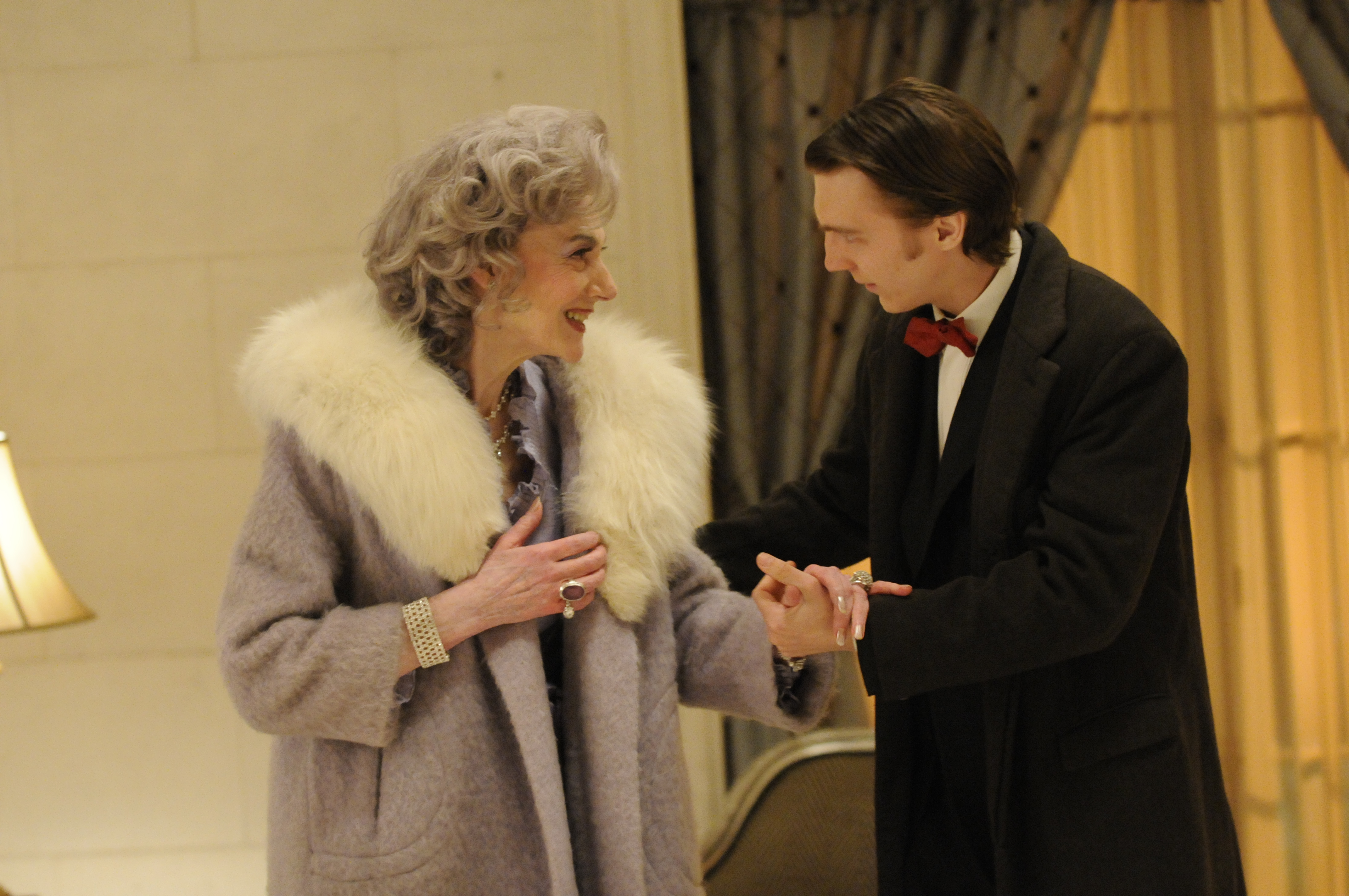
Such a review is short change perhaps of an otherwise decently delightful film, corner-stoned by the handsome performance by Mr. Kevin Kline, who does that for which he may be best known and earns again plaudits for doing it. Truly he has not been as good, in many years. Ms. Katie Holmes, however, a long way from her Pieces of April (2003) days, makes for an eery counterpoint in her vaguely transparent restoration of the ingénue's role: a poppy, over-lifted, and bewildering counter-culture-ette named (plainly) Mary. Limp between these distracting extremes, Mr. Dano supports himself until the script's all-too-nice yet still incomplete closure: rice at a wedding.
Grade: C+, a bon homme fine for a night on the town, when you can sneak in a little bubbly to springboard the evening. (With this film On Demand, doing so shouldn't be a problem.)
23 June 2010
Cover Art: Videodrome Blu-Ray

21 June 2010
Review: Nowhere Boy

Last year's Orange-British-Academy-Film-Awards nominated reinvention of the musically formative years of rock-icon John Lennon stirs up a lot of perhaps inspirational angst within and amongst its characters, as it now reaches States' side, yet it remains restrained enough to not tizzy itself completely beyond balance - a British virtue almost certainly.
In fact, most stabilizing of the film are its central performances, particularly those two (also nominated) by the supporting women in John's life: his absent mother, played with aplomb by Anne-Marie Duff, and his overly present aunt, played with tenderness by Kristin Scott Thomas. In terms of structure within the history of adolescent tales, these two women serve as the traditional feminine bookends: the permissive and the dismissive maternal figures respectively, whom a literate anthropologist may assign to the respective pleas and plights of developing children, attempting to reconcile their myriad with their limitations. In terms of between-spectator-and-spectacle interaction, these women serve as tacks, primarily by means of which the viewer may access the emotional contusions of John's particular coming-of-age tale. Subtly infecting this delicate balance between permission and dismission, affect and effect, is the uneven-handedness in the salience with which each of these women's roles in the film is portrayed in relation to the other's: While the novel daring of Ms. Duff's Julia Lennon is rejoiced even rapturously in impression's depth and duration in John's portrayed life, the surveilling caution of Ms. Thomas' Mimi is deferred often discourteously in impression's depth and duration in the same portrait. The effect of this imbalance is, yes, a more exciting film in the short run - exciting as small squirts of dopaminergic responses from indulging in fast food may be exciting - but, moreover, a plainly lopsided representation of John's key influences during his adolescence and in Ms. Duff's case an overrepresentation of the her character's. Though perhaps an honest depiction of the ratio of one to the other in this period of John's actual life, the audience the majority of which will not be so knowledgeable of his biography that they know this period's fully can not, without explicit appreciation of this fact, experience the full dramatic tension - indeed, the pivotal tension of this story - wrought by the motivational conflict between these two influential characters' personal quotidian philosophies. A balance more considerate of this fact than this imbalance in the film would have done wonders to improve it in spectral impact and impression - particularly in the long run.
Nevertheless, Nowhere Boy is a completely fine work that conveys the information that it wanted to convey about this particular period in John Lennon's adolescence. Actor Aaron Johnson, doing his female tutelaries fair justice in his own right, skillfully enough steers his protagonist through a minefield of potential hazards for maudlin clichés; does so with style, in and among costumes and sets of high order and craftsmanship; and walks away, having shed off most of the jeunesse that befell him early on. Directress Sam Taylor Wood hopefully in reality has done the same; we attend for her next film, to be sure.
Grade: B/B-.
20 June 2010
Review: Howl

Directors' Robert Epstein and Jeffrey Friedman's biographical adaptation Howl, exploring the personal and social implications of the eponymous poem by Allen Ginsberg onto his life and his culture, is at its best a finely acted and illuminative exposition of the work, set to the tones and times in which it was written. Leading actor's James Franco's performance is expressive and facilitative of the narrative back- and front-story of the author's personal and intellectual life. Though necessarily constrained by the circumstances of his appearances, Mr. Franco delivers in subtle ways that make the audience appreciate the sincerity of his efforts as much as they may the dedicated insights into his character's poetry, which is used as the template structure for the entire piece. Delicate and colorful animations realize the lyrical verse in timed interludes between the ontological and manifestly lexical conversation of the retrospective Ginsberg, being interviewed alone in his cluttered New-York-City apartment by an almost entirely unseen and unheard interviewer, with the philosophical trial, assaying and assailing the title poem for its perhaps brusk honesty to its permissively libertine characters. Favored actors and actresses (e. g., Jeff Daniels, Mary-Louise Parker) dot the trial's landscape with their own rather individually neurotic plays on perspectival archetypes, better written in the screenplay than perhaps given credit here, and the sea of faces, ever present in the eye of the lens by these actors and actresses' appearances and by the appearances of those others who form the audiences at that trial and at Ginsberg's reading, reinforce the notion of inclusion that the poem, it is argued, proposes to make (both of its characters as cultural touchstones and of its readers as the culturally touched). Negative elements, detracting from these aforementioned positive, may only be the rather simplistic triangular device, used to apportion the film to the three primary plot-lines that advance and together complicate its theoretically simple (i. e., straightforward) story, and the rather stiff way in which Mr. John Hamm (of Mad Men celebrity) insisted on comporting his character, a lawyer but not an altogether unfeeling man. Still, these instances of misguidance or misdirection are rather indulgent criticisms for a film that is otherwise an accomplishment of its major aims. For all this merit, Howl deservedly receives
Grade: A-/B+.
Subscribe to:
Posts (Atom)

 Posts
Posts


