 Genre: Drama (Biopic)
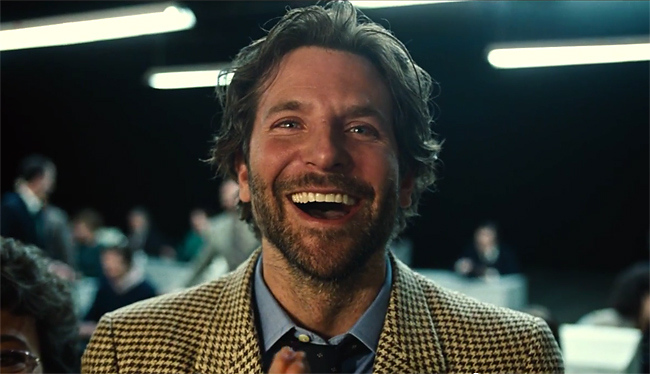
Mr. Russell, like a host throwing an at best tepid New Year's party, seems to think that a cool soundtrack is a sufficient mask for a flimsy mood, that no one will notice and everyone in attendance will still have a good time — at least, by publishing his new Joy, a biopic of a modern inventress, an audience member could hardly but think that he does. Joy is — in a word — a frippery. A fantastically told tale of a harried young woman who somehow against the wringing machinations of her self-centered family members bears up and finds economic and personal stability in the halls of QVC, the film is almost wholly unmoored from any realistic touchstone that might otherwise give emotional gravitas to its clearly intendedly emotional storytelling. Ms. Lawrence's flat performance doesn't help the situation. In fact, other than Ms. Elisabeth Röhm who plays Joy's half-sister as an adult, Mr. Cooper is the only performer in the film who truly delivers. He fully carries and makes magical the most redeeming scene in Joy, the second QVC scene. An understated delivery where other actors would have given full force, Mr. Cooper knows how to counterbalance the rhythm of the scene and build an interesting dynamic character, a great supporting turn. Otherwise, I can recommend Joy only for its production design — which, though good, unfortunately pales in comparison with the beautiful production design in other films this year (e.g., Macbeth).
Grade: C+, the staying power of a QVC sale.
05 January 2016
Review: Joy


15 June 2015
Review: Jurassic World
Genre: Action / Satire
A good film must always start with a smart screenplay, for the screenplay establishes the backbone onto which all the appendages of filmcraft are later embodied. Jurassic World, the fourth (for those counting) installment in the Jurassic film franchise, surprisingly had backbone — and much else to its credit.
Writer and director Colin Trevorrow and writers Rick Jaffa, Amanda Silver, and Derek Connolly wield the core artifice of the beloved franchise, not like a paintbrush by which to illustrate audience members' both light and dark dreams as the original franchise writers Crichton and Koepp did, but rather like a lance with which to sharply skewer the boil of inflating consumerism ironically coaxing on this already classic franchise. Indeed, the plot's structure is governed and seasoned throughout to smack the hand that reaches for what it offers with its own other. At every major plot point, the vital juices that like sugars the standard contemporary Summer blockbuster audience craves in epic battle sequences, jaw-dropping CGI, nightmarish thrills, romantic attractions (including especially lusts), and even familial bond trials are served up only to quickly thereafter be bathed in an acid wash of sardonicism, hyperbole, grotesqueness, or (in the best instances) irony. The audience is pummeled and jabbed while on the edge of its seat — no, because it is on the edge of its seat — and at times even fervently reminded that "more" is in poor taste. Of course, this essential element in the film is carefully coded, lest the audience be like the protagonist in Kubrick's (1972) A Clockwork Orange all too aware of and consequently upset by its violent attempted recondition. However, cloaks can only disguise figures to a certain extent; to a viewer who notices the inanity in the theme park guest who in the midst of an aerial attack chooses to save not just one but two cocktails from his outdoor table before running for cover, everything is apparent — and relieving, relieving of that one's expectations of the film have non-negotiable parameters into which everything must neatly fit to achieve maximal effect.
A key feature of the film, like any other film, is in the characters whose lives it follows. In a traditional Summer film, the stock characters representing ardor, bravery, comedy, or demonry are brought out, basically to wave at the audience and then retire flatly to the sofa in the back room. In this film, stock characters representing such traits emerge clearly but, like radioactive materials, then slowly decay over the course of the film, to reveal a thorough twist on the identities of the players. Nick Robinson's Zach presents as essentially a anthropomorphized penis, an adolescent entirely ruled by his sexual cravings (and sullen otherwise), but later resolves his storyline not with a heart-pounding kiss at the climax of action in the movie's final third — no, for we have already had such a kiss, diegetically commented on for a opening tone-setting element of satire, in the first few minutes of the film — nor even with the platonic bond-making chastity of fraternity — no again, for it is precisely this Spielberg-esque boyish wonder that obviously persistently entangles not only him but also nearly everyone else in play — but rather with a filial adherence to an older role model or "strong father figure", whose own virility by the way is so thoroughgoing that his romantic interest is bound notably to wearing high heels throughout the entire film for conceptual balance!
To say nothing of the Visual Effects, Sound Editing, or Sound Mixing — which were all stunning in their own rights — I must say simply that Mr. Pratt has perfected the definitive impression of a younger Clint Eastwood — both remarkable and horrifying in its own special way.
So, though of course this fourth installment into the Jurassic franchise had none of the novelty of its origin nor the untrammeled verve of its other predecessors, it has in its favor a sizable wry eye on its audience and for that alone I would say:
Grade: B/B-, a true modern fairy tale with a dash of something tastefully new. (Action porn seekers, look elsewhere.)
22 February 2015
The SpyGlasses Full: Official Winners (2014)
The following are my official winners for the year in film 2014:
| Best Film |
| The Grand Budapest Hotel Mr. Turner Song of the Sea Whiplash Under the Skin |
| Best Director |
| Wes Anderson, The Grand Budapest Hotel Damien Chazelle, Whiplash Jonathan Glazer, Under the Skin Alejandro González Iñárritu, Birdman Lasse Hallström, The Hundred-Foot Journey |
| Best Actor |
| Benedict Cumberbatch, The Imitation Game Jake Gyllenhaal, Nightcrawler Michael Keaton, Birdman Eddie Redmayne, The Theory of Everything Timothy Spall, Mr. Turner |
| Best Actress |
| Jennifer Aniston, Cake Essie Davis, The Babadook Julianne Moore, Still Alice Rosamund Pike, Gone Girl Reese Witherspoon, Wild |
| Best Supporting Actor |
| Ed Norton, Birdman [tie] Henry G. Sanders, Selma J. K. Simmons, Whiplash [tie] |
Best Supporting Actress
Adriana Barraza, Cake
Laura Dern, Wild
Keira Knightley, The Imitation Game
Lesley Manville, Mr. Turner
Rene Russo, Nightcrawler
Best Art Direction
Simon Bowles & Liz Griffiths, Pride
Suzie Davies & Charlotte Watts, Mr. Turner
Dennis Gassner & Anna Pinnock, Into the Woods
Adrien Merigeau, Song of the Sea
Adam Stockhausen & Anna Pinnock, The Grand Budapest Hotel
Best Cinematography
Daniel Landin, Under the Skin
Tomm Moore, Song of the Sea
Dick Pope, Mr. Turner [Honorable Mention]
Robert D. Yeoman, The Grand Budapest Hotel
Lukasz Zal & Ryszard Lenczewski, Ida
Best Costuming
Colleen Atwood, Into the Woods
Bob Buck, Lesley Burkes-Harding, & Ann Maskrey; The Hobbit: The Battle of the Five Armies
Milena Canonero, The Grand Budapest Hotel
Jacqueline Durran, Mr. Turner
Charlotte Walter, Pride
Best Make-Up
Christine Blundell, Mr. Turner
Frances Hannon, The Grand Budapest Hotel
Paul Gooch & David White, Maleficent
Peter King, Into the Woods
Best Visual Effects
Dawn of the Planet of the Apes
Guardians of the Galaxy
Interstellar
Into the Woods
Under the Skin
Best Original Score
Bruno Coulais & Kila, Song of the Sea
Alexandre Desplat; The Grand Budapest Hotel, The Imitation Game
Justin Hurwitz, Whiplash
Mica Levi, Under the Skin
Hans Zimmer, Interstellar
Best Original Song
"Everything Is Awesome" by Jo Li, The Lego Movie
"Song of the Sea" by Lisa Hannigan, Song of the Sea
Best Sound Editing
Jason Canovas, The Hobbit: The Battle of the Five Armies
Will Files & Douglas Murray, Dawn of the Planet of the Apes
Wayne Lemmer & Christopher Scarabosio, The Grand Budapest Hotel
Alan Murray & Bub Asman, American Sniper
Best Sound Mixing
Christopher Boyes & Lora Hirschburg, Guardians of the Galaxy
Johnnie Burn, Under the Skin
Michael Keller & Mike Prestwood Smith, Into the Woods
Gregg Landaker & Gary Rizzo, Interstellar Craig Mann & Ben Wilkins, Whiplash
Best Editing
Kirk Baxter, Gone Girl
Tom Cross, Whiplash
John Gilroy, Nightcrawler
William Goldenberg, The Imitation Game
Paul Watts, Under the Skin
Best Screenplay (Original)
Will Collins, Song of the Sea
Wes Anderson & Hugo Guinness, The Grand Budapest Hotel
Richard Linklater, Boyhood
Mike Leigh, Mr. Turner
Phil Lord & Christopher Miller, The Lego Movie
Best Screenplay (Adapted)
Walter Campbell & Jonathan Glazer, Under the Skin
Damien Chazelle, Whiplash
Nick Hornby, Wild
James Lapine, Into the Woods
Best Animated Film (Feature-Length)
The Lego Movie
Song of the Sea
Best Animated Film (Short)
The Bigger Picture
Feast
A Single Life
Best Documentary Film (Feature-Length or Short)
Finding Vivian Maier
Best Foreign-Language Film (Live-Action or Animated, Feature-Length or Short)
---
14 January 2015
The SpyGlasses Full: Official Nominations (2014)
The following are my official nominations for the year in film 2014. As expected, I have not had the chance to see every film that ought to be considered in contention this year, so certain films such as Fury and A Most Violent Year may yet tweak these nominations in certain categories. With that said and without further ado:
| Best Film |
| The Grand Budapest Hotel Mr. Turner Song of the Sea Whiplash Under the Skin |
| Best Director |
| Wes Anderson, The Grand Budapest Hotel Damien Chazelle, Whiplash Jonathan Glazer, Under the Skin Alejandro González Iñárritu, Birdman Lasse Hallström, The Hundred-Foot Journey |
| Best Actor |
| Benedict Cumberbatch, The Imitation Game Jake Gyllenhaal, Nightcrawler Michael Keaton, Birdman Eddie Redmayne, The Theory of Everything Timothy Spall, Mr. Turner |
| Best Actress |
| Jennifer Aniston, Cake Essie Davis, The Babadook Julianne Moore, Still Alice Rosamund Pike, Gone Girl Reese Witherspoon, Wild |
| Best Supporting Actor |
| Ed Norton, Birdman Henry G. Sanders, Selma J. K. Simmons, Whiplash |
| Best Supporting Actress |
| Adriana Barraza, Cake Laura Dern, Wild Keira Knightley, The Imitation Game Lesley Manville, Mr. Turner Rene Russo, Nightcrawler |
| Best Art Direction |
| Simon Bowles & Liz Griffiths, Pride Suzie Davies & Charlotte Watts, Mr. Turner Dennis Gassner & Anna Pinnock, Into the Woods Adrien Merigeau, Song of the Sea Adam Stockhausen & Anna Pinnock, The Grand Budapest Hotel |
| Best Cinematography |
| Daniel Landin, Under the Skin
Tomm Moore, Song of the Sea Dick Pope, Mr. Turner Robert D. Yeoman, The Grand Budapest Hotel Lukasz Zal & Ryszard Lenczewski, Ida |
| Best Costuming |
| Colleen Atwood, Into the Woods Bob Buck, Lesley Burkes-Harding, & Ann Maskrey; The Hobbit: The Battle of the Five Armies Milena Canonero, The Grand Budapest Hotel Jacqueline Durran, Mr. Turner Charlotte Walter, Pride |
| Best Make-Up |
| Christine Blundell, Mr. Turner Frances Hannon, The Grand Budapest Hotel Paul Gooch & David White, Maleficent Peter King, Into the Woods |
| Best Visual Effects |
| Dawn of the Planet of the Apes Guardians of the Galaxy Interstellar Into the Woods Under the Skin |
| Best Original Score |
| Bruno Coulais & Kila, Song of the Sea Alexandre Desplat; The Grand Budapest Hotel, The Imitation Game Justin Hurwitz, Whiplash Mica Levi, Under the Skin Hans Zimmer, Interstellar |
| Best Original Song |
| "Everything Is Awesome" by Jo Li, The Lego Movie "Song of the Sea" by Lisa Hannigan, Song of the Sea |
| Best Sound Editing |
| Jason Canovas, The Hobbit: The Battle of the Five Armies Will Files & Douglas Murray, Dawn of the Planet of the Apes Wayne Lemmer & Christopher Scarabosio, The Grand Budapest Hotel Alan Murray & Bub Asman, American Sniper |
| Best Sound Mixing |
| Christopher Boyes & Lora Hirschburg, Guardians of the Galaxy Johnnie Burn, Under the Skin Michael Keller & Mike Prestwood Smith, Into the Woods Gregg Landaker & Gary Rizzo, Interstellar Craig Mann & Ben Wilkins, Whiplash |
| Best Editing |
| Kirk Baxter, Gone Girl Tom Cross, Whiplash John Gilroy, Nightcrawler William Goldenberg, The Imitation Game Paul Watts, Under the Skin |
| Best Screenplay (Original) |
| Will Collins, Song of the Sea Wes Anderson & Hugo Guinness, The Grand Budapest Hotel Richard Linklater, Boyhood Mike Leigh, Mr. Turner Phil Lord & Christopher Miller, The Lego Movie |
| Best Screenplay (Adapted) |
| Walter Campbell & Jonathan Glazer, Under the Skin Damien Chazelle, Whiplash Nick Hornby, Wild James Lapine, Into the Woods |
| Best Animated Film (Feature-Length) |
| The Lego Movie Song of the Sea |
| Best Animated Film (Short) |
| The Bigger Picture Feast A Single Life |
| Best Documentary Film (Feature-Length or Short) |
| Finding Vivian Maier |
| Best Foreign-Language Film (Live-Action or Animated, Feature-Length or Short) |
| --- |
Review: Into the Woods

Into the Woods, Mr. Sondheim's most fecund piece, was not meanly adapted for the screen, but in being put there certainly expended some of its most precious resource, in his music and words. While Mr. Marshall's quavering hand managed to coax in a few fine moments, they composed the minority amidst a series of blanched others. Mr. Depp's one song, "Hello, Little Girl", and the princes' duet, "Agony" — both challenging, comedic, and lusty songs — were stripped of their verve, joke after pun lost on the audience, whose members at least in my company did not laugh there (or in many other places where they should). No, rather, the material felt a bit dull escaping those three actors' lips. Now, partially this fault is the actors'; Mr. Depp especially ought know better than to subdue himself entirely, when the song calls for more than the final burst of want. However, ultimately one must lay this fault at the feet of the director, for it is his and no one's else, the charge of bringing his actors to that point where the story is well told and its meaning well expressed.
Ms. Kendrick alone, revealing her Broadway training, managed to feel her way through the songs with independent intuition — though, it must be said, Ms. Streep's natural talent did guide her cleanly through most of her numbers. A similar appendum may be offered for Mr. Corden, whom this blog has not rightly seen since The History Boys (2006) and who has his own Broadway accolade to his credit.
The heart of the piece, however, beat erratically in the insufficiently wised Ms. Blunt, a striving but ultimately shortfalling Baker's Wife. Though to her credit her performance was better than I had expected it to be, it still ultimately left me wanting that thinness but cleverness of mind and feeling which, say, Tony Award winner Joanna Gleason had breathed into the role in its début; for Ms. Blunt too let jokes fall flat and emotions generally run off track when she wasn't paying well enough attention to the path before her.
Though I confess I was not raving, "Out of the woods! Let me out of the woods!", by film's end I was relieved to find that no more time remained for Mr. Marshall to risk fumbling.
Grade: B/B-, beautiful to see at times but choppy like the sea throughout.
13 December 2014
Review: Whiplash

What a thrill to see J.K. Simmons be given the length to stride full-swing in this his most recent feature, a new piece by new director, Damien Chazelle. Whiplash works off the model most popularized by last decade's Summer box office hit The Devil Wears Prada (2006); an imperious, supercilious mentor professionally imprisons a young hopeful with a certain flair and ambition in a cell of his own making and there, by callous conduct, smarts the upstart into learning a thing or two about not only himself but also his direction. However, unlike its predecessor, this film does not suffer from an embarrassing imbalance in performances; no, here the actor portraying the upstart holds his own against the would-be tyranny of excellence across from him, in the almost possessed figure hewn by Mr. Simmons (Ms. Streep in the aforementioned). Indeed, Mr. Teller, a new actor of increasing note of late, delivers an in all respects good performance; bittered but not brittled, starved but not starving, at times raving but never risk-seeking, the central performance of this film makes the ingenu a bleeding reality, unlike the surreality of clichés and choreographed imperfections seen elsewhere. Still, that Mr. Simmons is the star of this show can be no secret; stormy and snide, a paragon of cutting menace almost eerie in its alternating placor, the mentor whom he verves verges on the ecstatic, but like the music he adores and rules so fervently never topples, no matter how severe the spin. Bravo, sir; bravo.
And, as for the work of Mr. Chazelle, to know when to hold and when to unleash with a tidal storm like what he had in his hands is akin to his character's knowing whether he be rushing or lagging: hair's breadth to the average, stunning to the expert.
The praise, however, must not escape note of the man's writing. This screenplay is a clean and simple, focused(!) investigation of a dialectic centuries old, an investigation that still layers on a beautiful novelty to it.
Grade: A-, bonsai.
30 November 2014
Review: The Theory of Everything

Genre: Drama (Biopic)
It's not often that I see a promising film about a brilliantly interesting person become a weak treatise on a social issue still ahead of its time. For this — and almost only this — character, The Theory of Everything, the new film by documentary director James Marsh, is a piece worth seeing.
The film charts a rather linear biography, nothing new in terms of dramatic structure or even dramatic content, the protagonist struggling slowly with a physical decline as blossoming slowly on a mental incline all the while vying his generally swelling interests against those of his nearest and dearest — it's a perfect idea of genius as constructed and explored already (to varying degrees of success) by such films as The Aviator (Scorcese, 2004), Frida (Taymor, 2002), Jobs (Stern, 2013), and most relevantly here A Beautiful Mind (Howard, 2002) — and, while films like Frida and The Aviator have capably broken their material confines in order to relate and resonate the ineffable inherent in their stories — Taymor, for instance, by wondrous tableaux vivants and Scorcese, for instance, by hypercolor and sequential collages — films like Jobs and this new feature flop around ineffectively within the bounds of the material world within which they exist, consequently never demonstrating in so many frames the advancing genius that they nevertheless attest to portray. Take for example here an early scene, in which the young Hawking first perceives inspiration in the swirl of milk in his train-served coffee. There, the mechanism is, honestly, entirely boring; we the audience never feel as though we're leaving the quotidian meanness of the train on a pathway to delightful, groundbreaking work in the physics. Rather, we stick, bereft of the ineffable, in the simple porcelain pool outside our character's mind, still thus impermeable to us despite Mr. Redmayne's valiant attempts to communicate with us. Other instances of similar tenor fleck the arc of the plot of this film, the worst of which instances chars the serious romantic entanglements of the films' characters with almost flippant crescendo akin to that "flavoring" such modern melodramas as Twilight (Hardwicke, 2008) and The Notebook (Cassavetes, 2004) and the best of which instances (i.e., a simple fireplace shot through a sweater) only approximates the useful perceptual abstractions successful elsewhere. Overall, in this way, the film leaves more on the table than it ever should have and makes banal an otherwise drastically interesting story of a man who has contributed significant insights to the scientific canon.
Additionally, the film suffers from a split interest, a burden beset by the screenplay and unresolved by the director. While it proclaims throughout that it is indeed a biopic of the now standard form, it also bakes in the background a potentially powerful philosophical debate on a modern issue so new to popular discourse in cinema, that it has yet really to be discussed in such a mainstream vehicle: polyamory. Though it never outright addresses this lurker behind the scenes, the film constructs a narrative such that all roads lead to Rome (so to speak); the trials and questions in their romantic entanglements, previously referenced here, present the central characters, Stephen Hawking and Jane Hawking (née Wild), as multifaceted people both in need of support so ordinarily human that it's almost dull and yet in straits of being only partially able to provide that support to one another themselves alone. Their status, in short, is the classic recipe for a polyamor's solution to life: If one cannot for whatever reason find complete fulfillment in the promise of a single mate — and, perhaps, it would be nigh impossible for anyone to expect to do so, she thinks — then it is only meet for one to find complete fulfillment in a multiplicity of partners, only by a little stretch of imagination different in terms from the friends that conventionally monogamous couples retain or even newly make for reasons of social and emotional intimacy. Yet, because the film leaves this would-be marvel on the back-burner in refusing to court perspectives other than the ruling shaming of conventional society at large, this secondary interest of the film withers and then dies, leaving a corpse of a beauty looming as a burning pall in the background — and the black smoke only distracts and detracts.
Now, at the top of this review I said that this disenfranchised treatise is weakly almost the singular redeeming feature of this otherwise stiff as a board biography. So, it would be remiss for me to close this review without giving due mention to Mr. Redmayne, who reproves why he is a Tony-Award winner in this film. His performance of Hawking is limited by definition, but manages to turn these limitations into assets as he finds confidence within the constrictures of his physical form. What is important and demonstrates this fact is that he never lets the signals of his failing body, however heavy-handedly they were photographed by the other filmmakers, be the entirety of his condition nor even the focus of his action; instead, they are only punctuations of the major story that his body is telling, even at its later stages. While this performance is certainly not at the maximum it could have achieved, it is still one shining part of this work — and, likely, the only major part that will receive recognition from awarding bodies at the year's end.
Grade: C-, stale.
19 May 2014
29 April 2014
Review: Under the Skin

Jonathan Glazer pierces the veil and infuses possibility into black in his new film, the hauntingly emotive Under the Skin, featuring established ingenue Scarlett Johansson as protagonist succubus, charged with sexual and coquettish power to lure stray men into being dissolved of essences. The content of the film, then — sure — is a trying push at mainstream narratives — and, insofar as that push disturbs a subset of viewers, I am not interested. I am interested in, rather, how that push comments on filmmaking as an art itself; for Mr. Glazer's pinnacular achievement in this newest film is not that he can push some audience members' buttons (indeed, several fellow viewers walked out of the theater in which I saw the film while we were there) but instead that he can so competently and elegantly craft a viewer's experience that quietly subverts and eventually disturbs the central core of the viewer and simultaneously reëstablishes the storyteller's devices in his or her mind. He advances.
A prime example of this advancement is in his use of the color black in the film. Never have I before seen black used in such a way to such effect as those in this film. Black is typically the color of void, of nothing, of death and emptiness; here, however, black is the color of possibility. Early in the film Mr. Glazer meditates on black, a lingering mass over the frame sculpted via chiaroscuro with scythes of light, before ever letting form take over. This meditation is sufficiently long, to redefine black as a tool and element, as an instrument; the length, like the length of terminological discussion at the beginning of any verbal treatise, entails redefinition of previously commonplace ideas, so that we know that black is not simply the evacuated after-effect of the defaultedly primary instrument, light, but is instead more interestingly now the primary instrument itself, a crafter and not the crafted. This reading of his visual text is born out in several ways, but namely in how his characters and plotting points emerge all from it slowly and deliberately: Early in the film, a woman is carried up from a ravine by a male character, who has slung her over his shoulder. Neither person is visible to the audience until they together emerge from the blackness; the light does not make them, but rather is a filtration of the all encompassing black from which they just emerged. In the blackness, in the ether, they and all things existed and it was then and there that the director chose to draw them forth in order to describe his message. This inversion of the typical nature of basic binary color, light vs. black, is a tremendous achievement of a filmmaker who is no stranger to dramatic exploration and physical intensity (see, for example, his previous film Birth [2004]). To say that I was impressed smacks of understatement; I came to quickly understand far more about the devices of filmmaking than I had known before the viewing.
On that point alone this film would merit recognition. However, it is not simply artistic or narrative craftiness that recommends this film; additionally, the use of the instrument to follow through the delivery of a necessarily visceral tale is just elegant. Though at times the craftsmanship is perhaps bulkier than it could be, the capitalization on the redefinition of color throughout the film is wondrous. I am thinking now clearly of one exemplary shot as an example: the camera's hovering behind Ms. Johansson's head and there fixated on her hair, many strands exactingly filamented from the darkness surrounding them — a unitary conceit of what works in the entire film. How many strands are dependent and intertwined from one rounded origin and how easily few stray and blow in the breeze, them seduced by the gentle caresses of seemingly errant breezes operating noiselessly and invisibly in the atmosphere around, to coax and extract from the mass just several and, if done properly, not disturb the lot while doing so; how fitting the roundness to be but a superficial covering of control and thought and dream — the brain — in everyone and of beauty and strangeness in her in particular; and how investigative the careful juxtaposition of such layered lines in narration I cannot say enough. Cinematographer Daniel Landin, editor Paul Watts, and director Mr. Glazer all have done great work here.
The film is finally to be recognized for its commensurately beautiful sound design. Mica Levi's dissonant score and Johnnie Burn's precise sound design set the visual content of the film off in brilliant and startling relief against the reality of the viewer's world, where commonplace quietudes interspliced among jagged music prickle hairs.
Overall, while not perfect, this film is a strong strong addition to the filmic canon of this era — one that I would be sad to have missed.
Grade: A-, bravo!
02 March 2014
The SpyGlasses Full: Official Winners (2013)
Winners are below in bold.
Best Live-Action Film (Feature-Length)
12 Years a Slave
Blue Jasmine
Oslo, 31. August
Best Director
Woody Allen, Blue Jasmine
Paul Greengrass, Captain Phillips
Best Actor
Best Actress
Best Supporting Actor
Emory Cohen, The Place beyond the Pines
Best Supporting Actress
Sally Hawkins, Blue Jasmine
Carey Mulligan, Inside Llewyn Davis
Best Art Direction
Hannah Beachler & Kris Boxell, Fruitvale Station
Judy Becker, Jesse Rosenthal, & Heather Loeffler; American Hustle
Best Cinematography
Best Costuming
Best Make-Up
Mindy Hall, The Wolf of Wall Street
Best Visual Effects
Best Original Score
Carter Burwell, The Fifth Estate
Best Original Song
"Moon Song" by Karen O. & Spike Jonze, Her
Best Sound Editing
Best Sound Mixing
Chris Burdon, Chris Munro, Mike Prestwood Smith, & Mark Taylor; Captain Phillips
Best Editing
Best Screenplay (Original)
Woody Allen, Blue Jasmine (Honorable Mention)
Best Screenplay (Adapted)
Steve Coogan & Jeff Pope, Philomena
Joachim Trier & Eskil Vogt, Oslo, 31. August
Best Animated Film (Feature-Length)
Cloudy with a Chance of Meatballs 2
Best Animated Film (Short)
(Not Given This Year)
Best Documentary Film (Feature-Length or Short)(Not Given This Year)
Best Foreign-Language Film (Live Action or Animated, Feature-Length or Short)
La Grande Bellezza (The Great Beauty)

 Posts
Posts


