 Genre: Drama
I have to say, I wasn't quite sure of what I was expecting of this film when I was purchasing my tickets at the electronic kiosk this past weekend. I knew, of course, that two of its prominent actors, save the seemingly forever over-glanced Mr. McAvoy, had been nominated for the golden man in their respective categories; however, knowing also the rather shoddy choices that the people behind that man can and do often make (see here for starters), I didn't put too much stock in the promise of those nominations. Rather, I think, if I had been putting stock into any part of this film that may have been knowable before seeing it, I put it rather in the promise of the actors themselves, whose work I know in other films has been quite good (see The Queen [2006] and - duh - Captain von Trapp [The Sound of Music, 1965]).
Perhaps it was this expectation that led me to the distinct feeling of disappointment, creeping upon me like a puce liquid tide, briny and cold like salted Russian fish, while I sat watching the film. It wasn't exactly the performances per se that were so disappointing; no, rather it seemed to be settings of the performances that in comparison, like poor settings for decent precious stones, dulled and awkwardly exaggerated the nuanced features that went into each rôle. No doubt, in film studies, this bastardizing setting is aptly called the director and screenwriter, Mr. Michael Hoffman, who attempts to salinize an already sensationalized minor stop in history as if attempting to impregnate an old ovary that was scraped almost inadvertently from the bottom of a barrel.
Are these overly harsh words that I post onto this film? Perhaps; the work as a melodrama isn't really all that bad - Mr. McAvoy particularly stood out well to me and the art direction was certainly embellished enough. Still, watching an otherwise nearly endless repetition of hollow trades of ambition among rather unimpressive and relatively 2-dimensional characters was just winnowing on the eye and on the ear. I longed for the fully mature version of such tugs-of-war-like antics, for the great The Lion in Winter (1968), in place of what can best be comparatively characterized as the blind and utterly squashable pupa The Last Station.
So, Dame Mirren, Mr. Plummer, congratulations on your nominations this year; but let's try to really do something, more than just flaccor-redemptive work, in our next project, shall we?
Grade: C; meh.
P. S. Good lord, casting director Leo Davis, what ever possessed you to think that Paul Giamatti was in any way the right man for the rôle of Vladmir Chertkov? It's not that I know very much about Chertkov, but obviously obviously - yes, two "obviously" - a Mr. Giamatti he was not....




 Bright Star by Greig Fraser - With her able cinematographer Mr. Fraser, directress Jane Campion opens her film by pointing us to the Romantic sweeps of the pastoral hillsides, dotted by sheep and expertly costumed actors, in this image among others that aptly recall the landscape works of the then contemporary Dutch master-painters and set the stage for her dreamy historical tragedy.
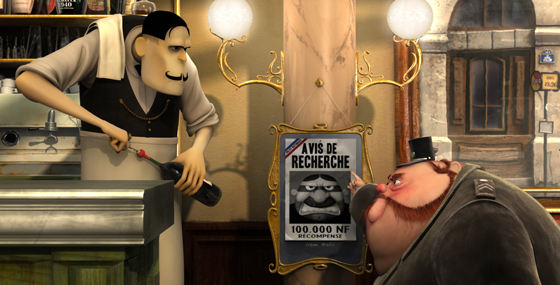
 The Secret of Kells by Tomm Moore - The surprisingly stunning animated feature The Secret of Kells is the former of two films on this list that well exceeded my initial expectations of visual aptitude in the feature. Fittingly described by guest-blogger
  The Hurt Locker by Barry Ackroyd - In creating a list such as this one, one simply cannot ignore this signature image from directress', Kathryn Bigelow's, hot-topic The Hurt Locker. A succinct and fateful allegory for the inextricable puzzlement weighing down upon the men at the heart of her film, this image depicts her protagonist (played skillfully by Jeremy Renner) unearthing a literally explosive network of bombs from underneath the dusty and dry Iraqi soil.
 The Messenger by Bobby Bukowski - Director's, Owen Moverman's, also surprisingly (visually) adept feature The Messenger was the latter surprise-feature of this year in film 2009 for me: Delicate, sensitive, honest, earnest, and entirely captivating, the film is a work of serious, gracious mettle. The image that I've selected from it depicts the quiet, ochre-stained removal of the film's protagonist from his world, both a world of feeling and of people; alone thereby in his sparsely decorated bedroom, he plays at disguising himself, even in the dark and solitude, while trim memories of his history figure awkwardly in the lamp-light.
 歩いても 歩いても (Still Walking) by Yamasaki Yutaka - Perhaps the most perspicacious film of the year 2009, Hirokazu Kore•eda 's 歩いても 歩いても (Still Walking) richly observes the extremely delicate interpersonal threads, weaving together a rather disparate family on the anniversary day of a beloved family-member's past death. Though few images from the film recapitulate the natural breath-taking-ness that possesses many other images on this list, such that those other images can almost stand as stills on their own, this image from Mr. Kore•eda's film is certainly one that does achieve equivalent power, by sparing nothing and attending to everything: The image here at #6 depicts the altar, sustained for and ritually honored by the family of the deceased, where it stands deceptively as a superficial common-place fixture in the family's house, deceptively as a deep and literally and figuratively central pivot-point in all the family's emotional turns.
 L'Heure d'Été (Summer Hours) by Eric Gautier - While perhaps not an architecturally formal film in its cinematography, the images of director's Olivier Assayais' contemplative work, much like the images of Kore•eda's 歩いても 歩いても (Still Walking), communicate nevertheless deftly by including in coherent fashion the passing affections that its characters allot toward their fellow others as well as toward their artefactual surroundings. In perhaps the epitome of this style of passing depiction, this image, from the third act of the film, centers (in constant revolution) around a desk that had once been integral in life but since has been quite displaced - even from its accompanying chair - in the cold and artificial podium of museum, whose relics and reliquaries are dimly acknowledged by the touring hoards, featured at back from the back, in passing. At frame's left, a member of the coterie who knew the desk before its current state looks on, herself quite displaced, at the creation of artifact - bravo.
 Inglourious Basterds by Robert Richardson - Half too structured, half too quick, Mr. Richardson's cinematography for Quentin Tarantino's spaghetti-Western vacillates between gorgeous absorptions of the stunningly executed sets and art-direction and gratuitous divulgements of the brass and comedic quippery that really sets this top of a film a-spinning. Though impossible to say whether either approach is exactly wrong or exactly right - really neither alone is, which is quite the point - the resultant images as a better whole did stay with me well past the first viewing. For that stickiness alone, the work deserves a place on this list, but all the more it receives such a place here for this #10 image of Marcel, Shosanna's Black lover confidant and accomplice, standing silently in the half-lit space behind the film-screen, where the eye of film trains on him - a deliriously reflexive and bountiful still.
 Los Abrazos Rotos (Broken Embraces) by Rodrigo Prieto - Not an especially visually pleasing film, Los Abrazos Rotos, written and directed by Pedro Almodóvar, nevertheless does have one image poignant enough to merit placement on this list, in whimsical slot #11: the temporally tense, essentially self-referential still of protagonist's Mateo's now aged hands vainly groping for the faintest wisp of textural revision the staticky frames of his last fleeting kiss with his muse and lover (Penélope Cruz), a kiss remembered now only by himself and by the film, two mutually exclusive eyes that hinge on the same image yet exist in radically different spheres. (While the addition of the wristwatch on Mateo's wrist does feel a bit heavy-handed,) the electricity of this shot cannot be dissuaded (by such hyperconscious details.)
 Posts
Posts


