The Academy of Motion Picture Arts and Sciences, the group that yearly gives us the Oscars, has just released its celebratory poster for this year's awards. The poster's design features the poster art for most, if not all, of the Academy's 80 Best Picture award-winners, including a question-marked space for this year's recipient. The posters are arranged seriatim according to year and conform with a spiral design that, when viewed as a whole, mimics an Oscar statuette. Combined with a classy backdrop and a written list of the titles of all the featured Best Pictures, the imagery of the poster looks simply beautiful, which is why I just had to post about it. Enjoy, people. There are about 4 weeks until the awards' ceremony.
25 January 2008
"80 Years of Oscar" Poster


22 January 2008
Heath Ledger: Tragedy
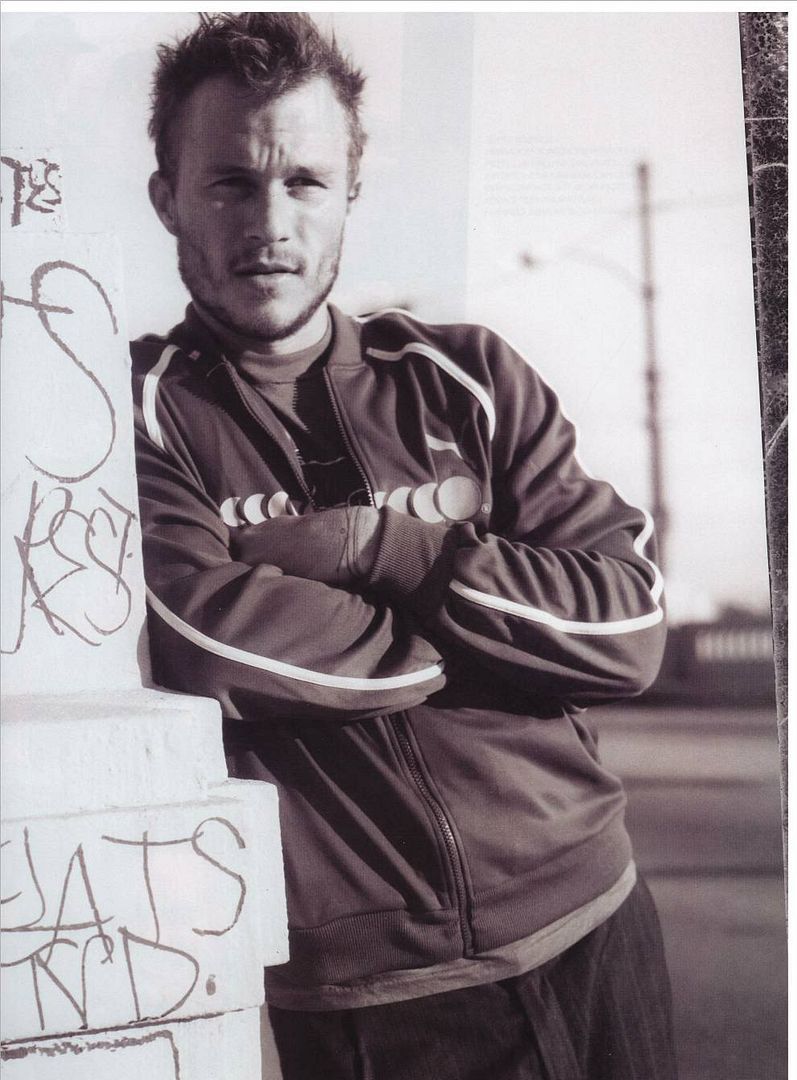
I'm speechless.
Here is a link to the "Breaking News" article on CNN.com.
From the Times:
"At 3:31 p.m., according to the police, a masseuse arrived at the fourth-floor apartment of the building, at 421 Broome Street, between Crosby and Lafayette Streets in SoHo, for an appointment with Mr. Ledger. The masseuse was let in to the home by a housekeeper, who then knocked on the door of the bedroom Mr. Ledger was in. When no one answered, the housekeeper and the masseuse opened the bedroom and found Mr. Ledger naked and unconscious on a bed, with sleeping pills — both prescription medication and nonprescription — on a night table. They moved his body to the floor and attempted to revive him, but he did not respond. They immediately called the authorities."
The Reaction to the Cloud
And the nominations have been announced.
Other than the blah support for Atonement that almost knocked me over, I was surprised by a few things:
- the screenplay for Away from Her being nominated, because it definitely wasn't spectacular - but then the offerings for that category weren't spectacular in general this year
- the screenplay for Ratatouille being nominated, because it also wasn't spectacular - but then they love their Pixar
- the curve ball that was the nomination for Surf's Up as animated feature
- the unexpected, yet still expected absence of Le Scaphandre et le Papillon from the Best Picture category, which to me only attests to the old-school, unadventurous mentality that plagues the awards
- the unexpected show of double-love for Cate Blanchett, who, while always wonderful, did not strike me as outstanding in Elizabeth: The Golden Age, especially not more wonderful than, say, Amy Adams in Enchanted. (Huzzah for Laura Linney though!)
- and the actually expected show of no-love for Sean Penn, who not only failed to get himself a Director nomination (and Emile Hirsche an Actor nomination), but also failed to have his marvellous Into the Wild nominated as Best Picture - how could they do that? Don't they love Sean Penn over at the Academy? I thought for sure they'd eat that shit up - ("shit" colloquially of course - I mean, I called the film "marvellous" sincerely, to which my personal nominations can attest [see right]).
And:
- Wow, all three songs from Enchanted?! They were good, but they weren't that good. I sense nostalgia for the Menken of yore. (Meanwhile, the ignorance-fest for Into the Wild shuts out Eddie Vedder from this category completely.)
- Nothing for Harry Potter and the Order of the Phoenix! Boo! Really, it deserved at least one recognition somewhere...
- ...meanwhile, ugh, Atonement gets into the cinematography category - that just bothers me
- Interesting choices for musical score - I didn't find Michael Clayton or Ratatouille to be very exceptional and I have not seen - well, heard, I guess - The Kite Runner or 3:10 to Yuma
- Across the Universe for costumes? - but then the costume nominees usually contain one that is way out there and of a film that wasn't great (e. g., Troy). (Huzzah for La Vie en Rose though!)
- and hooray for the Animated Short nominees!
--------------------------------
And, now that I've slept, some final thoughts:
- About score: The Michael Clayton score is a big "what?" to me; I can appreciate minimalistic background but this just feels unspecial. I don't mind the Ratatouille score, but it is very typical. I wonder, could its being nominated be a recompensatory recognition of Michael Giacchino for his more unique work on The Incredibles? The 3:10 to Yuma score is actually thoroughly enjoyable and am for its having a nomination. And The Kite Runner sounds like a knock-off version of your wonderful score for The Constant Gardener, Mr. Iglesias.
- About editing: I'm glad Le Scaphandre et le Papillon and Into the Wild got in there. Frankly any Into the Wild love is glad-making.
- and about screenplay: ....
In the Shadow of the Oscars
So, the nominations for the 80th annual Academy Awards are due to become official tomorrow morning (though some sources may have had an insider's peek). For many, their announcement is yearly the cause of much anxiety and anticipation, since the reaction to them always seems to indicate that the films that the Academy chooses to either nominate or not nominate accordingly either gain or do not gain respect ad finitum in the Zeitgeist opinion of the general public - a phenomenon I like to call the clever misconceptions of the historical present (e. g., the existence of people who earnestly believe Crash was the best picture of its year). For me and, I suspect, for many others who enjoy taking a greater interest in the actual merits of film, the nominations of the Academy (and indeed their awards themselves) are nothing more than the opportunity to see how much the popular gurus "got right" (oftentimes according to our own personal observations) - well, that, or the opportunity to exercise our sports'-fan's-like competitive spirits with others like ourselves (but that's a whole different story).
For my own part, I just posted the final nominations for my own little awards (on the right) and, because I'm a dork who can't resist, I will be waking up early to watch the Academy's nominations' announcement to see "how well we've done." I know that my pushes for films like The Darjeeling Limited are far-fetched to any savvy "Oscar-tracker," but I stand by them all. (I mean, Mr. Anderson's work is not continually admitted to the Criterion Collection because it's bad.) And among the best of the others I stand boldly in the shadow of Oscar: Mr. Idziak's brilliant cinematographical work on Harry Potter and the Order of the Phoenix, Ms. Garner's striking performance in Juno, and Ms. Lynch's captivatingly ephemeral portrayal in Harry Potter and the Order of the Phoenix; and, though I contend that the Oscars actually mean very little nowadays in terms of true achievements, fingers are nevertheless crossed in hopes that they recognize these worthy pieces.
Until the morning...
19 January 2008
Review: Le Scaphandre et le Papillon

So I finally just saw Le Scaphandre et le Papillon today and, for the first time in a while, I discovered that the work had not been, to a disappointment's effect, extenuously overpraised in the media. Instead, I discovered that it was as many have already been saying, a wonderful and deeply beautiful description of one man's struggle to uncover and improve and express himself in the world; and, although that bit of plot detail may come off as more than a bit cliche and 'senti-metallic,' I assure anyone who may doubt me about it that, a former cynic myself, my similar doubts were quelled (and thoroughly quelled at that). From Mr. Kaminski's brilliant cinematography, that simply overwhelmed with its power, to Mr. Harwood's faithful adaptation, that glowed and radiated in its unembellished honesty, the film is clearly one of the best of the year.
To begin with, the film in its very first moment immediately breaks the divide of spectator from spectacle. Much of the entire film was shot in the first person, in a way that places the spectator within the visual confines of the struggling protagonist, and thus allies the two parties in that way. An extremely incisive and potent perspective, that alliance allowed the film to achieve true and unglamorized - ahem, Atonement - audience immersion, a phenomenon that roots strongly into the very foundational aims for the medium film - no, even (narrative) art in general - itself (i. e., the possibilities for consciousness' extension, metaphysical escapism, the persistence of memory, etc.).
These philosophical ripples were then supported by and symbiotically raised with an equally probing screenplay, that consciously investigated the limits of what it is to be 'human;' to have form, body; to think; to be thought of; and to create. Mr. Harwood delicately etched all this out from the original text marvellously, without any sensible or significant loss of strength; and additionally he found it within his capabilities and talent to cohabit these weighty discourses with the light and yet still emotionally and psychologically relevant portraits of the common tugs-of-war of the everyday and the people. In one rushing swift he touched on the quickly passionate anguish many feel when almost viscerally immersed in a televised sports' event and then cascaded smoothly into a solipsistic exploration of the larger-scheme, vital exasperation that can be extended from that rather quotidian origin. (When one is forced in on oneself, to rawly confront and really scrutinize oneself, in absence of all other things, all other beings, can what is commonly understood by the word "passion" truly be felt or achieved, or is that phenomenon solely and entirely an artificial, associative reaction to otherworldly things, a condition inspirable only by those things and those people absented outside of oneself?) And, for such tremendous tackle and ambition, he never once failed or faltered, but instead delivered and drove consistently rhythmically to as much of a conclusion as anyone can be said to have reached.
Intelligently, this philosophical questioning and journey was exactly and subtly mimicked by the quiet, evolving structure of Mr. Kaminski's cinematography. Much like the papillon's emergence from its scaphandre, the visuals of the film gradually reached beyond their starting point, to achieve a new frame, that of an abstracted self, an outsider, gazing within, gazing at the vessel from which it emerged. The transference from the initial first-person's perspective to a slowly more preponderate third-person's perspective illustrates this point most clearly; but Mr. Kaminksi marked all the story's archs in this way, extracting the proximal and the intense into the expansive and the resonant, and wove the film even tighter still by interlacing iconically significant, touchstone-like images at regular intervals throughout the film (e. g., the aquatic descent and the rigid, [old-world] full-body diving suit). Needless to say, the effects of all these aspects and designs were quite exquisite.
Together, the screenplay and the cinematography led the film's connoiter with concerns of the body, the mind, and the inexiguous delineation of the self as well as with the finesses and furies of human interrelations, especially intimate ones, but it was Mr. Schnabel's skilled direction that really gave all of it its flair. Drawing out spot-on performances from his cast, whom he superbly arranged in his spaces, and timing well the weight of each piece of his work, he quite elegantly oversaw his story from its at-first-instant beginnings to its majestic ends. He allowed the tragic to be tragic, the intimate to be intimate, and the funny to be funny and never let any one of them run away with the other two; and he made sure to extirpate any even meager sign of mill humor or pity or repulsion from his lush and sculpted filmscape.
Yet, for all its polished and clean and well conceived depths and surfaces, the film was not absolutely impeccable and, I feel, no matter what the condition or the origin of a work, unless perfect it can always be offered a little constructive criticism. In this case, I have three such comments. First: While I understand that, being based on a true and recent story, the film had little choice but to be allegiant to its source material, it also on the other hand could have taken some small, non-radical liberties without disavowing its source, in order to really crisp up and realize its source's at-least subtextual emotions. For example, I felt that in the first act, in which the protagonist learns of his "locked-in" condition, he could have more clearly been seen to go through the several stages of grief over personal loss that are to be expected in a situation like his. While confusion, displacement, despair, and acceptance are all there, the anger or frustration component I thought was lacking. If it had been more present, the audience's introduction into the body of the plot could have been more smooth and complete (though, without it, there is but a minor crease in the film's fabric [that may be arguably excused by references to the protagonist's character or personal nature]). Second and related to the first: While the borrowed music of the film was certainly strong and felt and very present, I thought the work as a whole could have used a more present, more solid original score. Mr. Constantin's and Mr. Cantelon's themes were a little too shy, too placid, too sedate for the film's fierce heart in my opinion. Third: While I understand the symbolic significance of the glacial imagery that figures throughout and at the closing of the film, I did not feel like it was a thoroughly sound analogy to make. Glaciers suggest coldness, frozenness, and 'in-fecundity' or 'in-arability' in addition to vastness, desolation, cohesion, etc.; and so they put me in mind of unsustainability, inaccess, and fruitlessness, which obviously stand in direct contrast to the tenets of the film. Perhaps fish in fractile, glass fishbowls would have been a better piece of imagery.
Nonetheless, despite these small constructive critiques, I did definitively admire the film and all the people involved in its creation. I strongly encourage anyone who have not yet seen it to soon do so, for in all its facets it was a tight, pointed, and affecting piece of work, with cinematography, a screenplay, and direction that stand out as some of the best of the year. And, them adeptly probing very profound, very current areas of philosophy, it sincerely was a tremendous work.
Grade: A-
17 January 2008
Animation Slip-Up? Or Just Snazzy Privy?

How to Hookup Your Home Theater
I Met the Walrus
Madame Tutli-Putli
The Pearce Sisters
Prokokiev's Peter & the Wolf
Best Animated Feature
Persepolis
Ratatouille
The Simpsons Movie
SATC Lameness
SATC - that's Smart-Ass Title Creatives - recently finalized the official poster for the upcoming and much anticipated Sex and the City movie, due in theaters this summer. Needless to say, they failed terrifically at being clever: "Get 'Carried' Away." as the tagline?? Come on, people; at least try a little. How about "L'amour c'est chic encore." or, if French should be too exclusive, "Cosmopolitan with a twist." (which both took me at most ten minutes to write)?

09 January 2008
Review (Theater): The Little Mermaid on Broadway
Genre: Musical / Fairy Tale
The Little Mermaid's appearance on Broadway marks the latest attempt in a string of productions at trying to translate a popular and classic Disney success across from animated film and onto the live stage. While past and some still current attempts have been admirable, none has made that translation well thoroughly and, I am sorry to say, The Little Mermaid is no exception. Stiff where it should have been fluid, short when it should have been full, and caricatured all over, the production in but few ways lives up to the great standards of its source material, Disney's masterpiece 1989 film; and, unbolstered by great acting or orchestrations, it could hardly have been commended more fulsomely.
My main complaint with the work is with the liberties that the writers took when adapting the play to the stage, for the changes figured more as a quite double-edged sword than a global improvement (or, even, maintenance of status quo). Putting aside my exacting qualms over their blundering of mythologies - Triton and Poseidon were not son and father and immortal gods cannot die(!) - I fall to (first) the metamorphosis laid upon the Ursula character, which, I'm guessing, was done as much for the musical adaptation as for the want to accommodate the actress portraying her, whose physique and vocal range quite differ from the film's Ursula's. Now, to be clear, I'm not lobbying against the fact that there were changes made to Ursula (or to any character for that matter) in general. Of course one cannot expect any trans-media adaptation to produce the story entirely unscathed; exact replication, especially one made so many years after the source material's creation, is a fool's hope; and alterations done in any such adaptation are often necessarily so for the simple matter of the differing media. A live Ursula, for example, could never be expected to capture the same exact swirling, oily avarice as an animated Ursula could; fluid tentacular movement and stroke-perfect energy would by far elude any actress trying to impersonate that Ursula in reality. So, the effects laid upon the Ursula of the show that had her seething in an embellished backstory akin to that of aging starlet whose heydays are days long gone by were interesting, potent, and not incongruous with the original. They gave the actress license to limit her movements, as a dramatic lay-about would do in expectation of being waited upon by her doting servants; plausibility to sing, albeit still grittily, within a higher range than the original, as a former tall and blond showgirl, long past her prime, would do; and most importantly great reason to act as saucily, cruelly, and sweetly underhandedly as she possibly could, exactly as a fame-obsessed, desperate has-been would do if given the chance to rekindle her glory. So then why why why was her dialogue written so fluffy and her demise so feeble? It was practically an offense to the character that she was hardly ever seductive or sadistic in her power over her servants Flotsam and Jetsam and it was clearly an offense that, for all her heighth and might, planning and deviation, she was such a push-over in the end - vanquished by the mere smashing of her huge, obviously delicate, and scandalously unprotected shell that was, not only so predictable for everyone in the audience miles beforehand that even the six-year-old girl in the row in front of me had guessed it by intermission, but also so inevitable for everyone in the production that even the actress playing Ursula hardly put up a fight in hope of preventing it! It was verily outrageous, especially considering the fact that Ursula has time and again been considered one of the most (wonderfully) vicious villains (if not the most vicious) in the entire Disney canon! And the writers' liberties only got worse from there on: Scuttle, the somewhat beloved slapstick reprieve from the heavy drama, was by light-years too far expanded and given two(!) solo songs neither of which had more substance than the stock fart joke and one of which was poised as the practical second-act opener! Sebastian, the moral guardian of the story, was quite awkwardly and rather interjectedly given what one can only assume was a lover; and Flotsam and Jetsam were demoted from slitheringly wicked servants/underlings to a a sort of bizarre/vaudevillian, comic duo. New song lyrics were at best fatuous and cake-easy and the anally symmetrical character tree added an unpleasant level of two-by-two match-y-match-iness and incest to the very present sexual undertones that the story inheres. Needless to say: I was somewhat less than thrilled by the blueprints.
And, like I mentioned earlier, the action/construction based on them was basically like spraying a whole lot of hairspray onto the open flame (of quality and integrity burning). Ms. Scott's (i. e., Ursula's) performance let on nothing of her slighted status, former celebrity, or acrid avarice for her return to the spotlight more than the little ditty "I Want the Good Times Back" (also known as I want the source material back) could muster. The song reeked of statutory design and show-tunes-y shimmer, and her singing of it and her other numbers was much more talking than actual harmonizing. Add to that the fact that she barely moved from what appeared to be stiffness and duress (likely due to the action-restrictions of her overly-ambitious costume), rather than deliberation and character meditation, and the fact that she maybe once out of five times emphasized the correct word in the line or phrase; and then you can approximate the level of her stage presence. Ariel (Ms. Boggess) was the wholly unremarkable, insipid and preening fluff that, I guess, they wanted her to be, her voice no where near the power or raw feeling that it is supposed to communicate; and Triton, her father, (Mr. Lewis) was generally quite weak and unimpressive, despite his scriptedly magnus animus and aggressive turns. The only performances that on the whole positively stood out to me were that of Mr. Burgess (i. e., Sebastian), though his lungs felt quite not powerful enough to support his two milestone numbers - he was visibly winded, skipping lyrics, during "Under the Sea" - and that of young Mr. D'Addario (i. e., Flounder), whose typical deficiencies as a child actor were in this show outshone by his strong singing voice and his marvellous ability to remain in character regardless of whether or not his actions be the current focal point of all the action on stage. However, I must add that in a better production the qualities of these two performances would have only been average and therefore probably would have not stood out to me so positively.
The musical score, especially during the first act, was frenetic and completely incoherent, as vaudeville(?!)-style stage numbers were filed in between the rich, orchestral original songs and (as) the whole tightly woven instrumental work of Mr. Menken was subjugated under the fatty weight of showtunes pop. At any moment, I was half-expecting, big-band would come out and bash the whole thing into unrecognizable distress; and my concerns were only mildly diluted by the (inventive?) reuse of the original latter-story instrumentals to flesh out the courtship phase of the story with some few new, actually congruous(!) songs.
The set design, light design, and costume design were beautiful, if you happened to be a tastelesss, artless seven-year-old girl particularly fond of neon pastels, glitter, and plastic jewelry. The exceedingly festooned, drug-store--nail-polish toned sets sizzled and cracked out the red end of the saturation meter immediately upon curtain up under the tartly warm red, yellow, and purple(?) lights - leaving little to nowhere for them to go during the intrinsically burstingly motivated scenes (e. g., "Under the Sea") - while the lights themselves discarded any sort of intelligent scheme that they otherwise might have achieved contrasting warm with cool hues, colors with their complements, benevolent with malevolent emotions, or dramatic with comedic moments. And the costumes, though all intricately worked and detailed, too often ascribed to that curious brand of half-prudish, half-parade-oriented kitsch that seems peculiar of Disney and its real-world 'imagineering' to be seriously, earnestly appreciated.
And the rest of the shows failings I must lump onto the director, Ms. Zambello, who for some reasons unbeknownst and unguessable by me, not only assumedly instructed results in the aforementioned degrees, qualities, levels, and manners, but also and moreover approved them for opening night.
No, no, Disney, you were not the exquisite fantasy-land of possibility for this prominent inner child this time. Whatever success you derive from this latest investment may only be from the good name that is the card that you play by rousing and redressing your classic masterpiece. And, I'm sure as there were the scores of critics also present at my Tuesday night's performance, my particular showing was not an anomaly.
Grade: C/ C-: Mediocre and disappointing

21 December 2007
Review: Sweeney Todd: The Demon Barber of Fleet Street
Genre: Musical / Morality Play
It was obvious from the very start of this project that it would take a tremendous amount of careful effort for Mr. Burton & Co. to finely winnow down Mr. Sondheim's classic dark drama from its more original sprawling length to a format more suitable for the screen, one less encompassing, less for a live audience, yet still equally as powerful, or dynamic. Songs would obviously have to be trimmed, if not hedged altogether; dialogue bundled; characters redirected; and even blocking smartly reshaped, to accommodate the comparatively limited window that is the frame (comparatively with the open stage). In short, the whole thing was to be chopped, condensed, as best as its varyingly shaped pieces could, to become a faster, tighter Sweeney Todd - o , wait: that's actually not a disastrous enterprise at all, but rather an extremely exciting venture: a faster, tighter Sweeney...hmmm. It would mean then more quickly delivered punches, more severely reverberating cadences, and just generally a more sharply rendered story; concisely, a probably would-be improvement on its staged blueprint. After all, the other effects of the change of medium could only be immensely beneficial (i. e., the huge, unlimited structures and locations, the possibility of smooth, unsequestered scenes thanks to editing, and the potential color-tinting variations of post-production, contemporary cinematography).
Such were my thoughts as I sat in the theater last night before the premiere, midnight showing of Sweeney Todd: The Demon Barber of Fleet Street, and as I sat and thought I could only become more excited by the possibilities of it. Would it be beautiful? Would it be sharp? Would it be as good as it could be? And, when with the intoning gothic chords it finally began with a thrill I thought that, indeed, it may be.
Yet, I began to worry as the opening credits animation-sequence grew on, with its sickeningly overripe reddish hue whose texture existed somewhere among melted latex, candle wax, and blood. That was the first sign; the almost comically pop-culturated blood ominous indeed, for how seriously then could the film treat its most basic principles, its very groundwork, in morality? I hoped things would change and, as the animation fell away and Mr. Depp entered the frame, albeit behind a boy who looked more the gaunt, heroine-chic Dior model from Scandinavia than the innocently amorous sailor - but that's another story - I did my best to let the creeping suspicions of failure fall away. "No chorus?" No chorus - hmm, there was no hauntingly singing chorus to introduce him and his story to the audience, no moralizing catalyst by contrast and omniscience but we, the audience ourselves - bold decision, Mr. Burton. Let it be then and, his song finished, I was quickly torn away through the varyingly black streets of Todd's pit London, with hardly a second's hold to really ingest it all, the squalor and the picture-book scenes. The camera instead rode heavily on him, Mr. Depp, intensely close and scrutinizing - hmm, another odd choice: why decontextualize, especially when Mr. Todd is so emphatically a product of his environs; why alienate me, the audience, so so strongly from perspective, especially when we are now the moral adjudicants? Well, push on: mm, more flat grumbling from Mr. Depp but then, ah, a light: Ms. Bonham Carter, floured out and rolling quite deftly in her own private shoppe. It was clear, from her entrance, that this film could bear fruit after all. Undespairing, I settled in and listened.
What I found ensuing over the next forty minutes was much of the same: sparse, indelicate introductions and establishments, dissevering perspectives, and the wicked balm of Ms. Carter's Mrs. Lovett at pains to smooth it all. It was not at all the Sweeney Todd I had so hoped it would be. And I wondered, why wasn't it working? Yes, there was all I mentioned contributing to the shortcoming, and so, all right, Mr. Burton & Co. found their self-appointed task of inexiguous, concise adaption (at least in the first act) a taller order than they would muster; but there was something deeper turning wrong. And then I recognized it, so clearly that it nearly knocked me over: the performances, they were, none of them (except for Mrs. Lovett), anywhere near as crisp, as sharp, as raw as they should have been. Where they should have been steaming hatred, there was only a simmering seed; where a violent call to reaction, only a crusty obligation to deed; and, where a perfervid longing to break free, only a simpering, whimpering indolence to go. Mr. Depp's, whom I much otherwise admire, Mr. Todd was flat, undynamic, and distant. Mr. Rickman's and his Stupin's ward, played by Ms. Jayne Wisener, were much the same. And Mr. Baron Cohen's Sr. Pirelli, though indeed comedic, lacked a similar lustre. Mr. Spall seemed to be the only actor who really tried to add to his character and three-dimensionalize him from the page and from the otherwise stagnant stew of his castmates, but his efforts' product felt too caricatured to be genuine. Again, only Mrs. Lovett really stood out as a character of significant complexity and depth. But why? Why?
I considered the question seriously and in doing so I was forced to go back and reconsider, not only my opinion of the performances, but also and moreover my entire starting point for opining in general. This is a morality play, it was clear, and perhaps I had therefore approached the thing all wrong. I had been looking for plot prominence, character depth, and audience integration, but perhaps i was entirely misguided thus, way off and utterly daft to do so. Could these characters have been meant to be so flat, undynamic, and distant, so singularly motivated and two-dimensional on purpose? Could there be a finer, more complex innerworking here than I had previously considered or even dreamt of realizing? And, as the aforementioned forty-minute introductory period tapered off into the rest of the film, I was pushed deeper into my thoughts, because all of a sudden, and very surprisingly to me, everything just clicked. I wasn't sure whether it was because the songs had gotten better or I had learned to disregard those aspects of the film that I had previously conceived as faults; but truly everything just fell exactly into place. Tempo was perfect, balance ideal, plotline deepening; it was all really moving, even humming merrily along like clockworks, to an until-then unseen drummer (for I had the distinct feeling that that abstract master had always been there, the course of flow hadn't changed, I just hadn't found its font yet). I was astounded. And it hit me, far more strongly than my earlier recognition, this was a morality play. Its breed and nature exist entirely outside of the world of now traditional film as something older, almost archetypical, and certainly governed by its own set of rules. Characters did not have to be rounded, plotlines did not have to be of a certain depth; in this type of play it could make perfect and absolute sense to be at haste in getting over the mere introductory formalities, because they and the details of the plotline are so subordinate to the being and the details of the moral or conceit they exemplify. And at once what I had initially seen as the crumbled, poorly effected structures of the early portion of the film took on new life, as naught but the rickety unembellished framework jogging into play, accomplishing everything it needed to, cleanly and simply. And, as I pared down my interpretations of the characters, I also recognized that the reason why Mrs. Lovett (at her basic, on-the-page form) had stood out from the rest for me is because her sticking point and singular motivation is by its nature necessarily more "complex" (as the word is ordinarily considered); active emotion and conscience manifest her, as she was designed to be the only player who has inklings of self-awareness about her, as she is the sage, the augur, the portent. It is through her that the true moral grappling is worked and exemplified, and so she is the keystone of the entire piece. I fell back in my seat and absorbed it all.
The film had been completely beguiling, and I was confounded by how a film that seemed to be so lacking in so many ways could pick itself up and turn itself around, almost entirely reoriented in my mind, to become so lucid and full and hard-hitting. Of course, it was unequivocal how visually beautiful it had been. Colleen Atwood is endlessly talented at her craft, and her costumes meld perfectly into the alternately bright and dusky hues of the art direction and production design. Mr. Sondheim's songs were also enchanting, and so the audial part of the film was too decidedly lovely. Yet, the meat of it...so tricky. Of course, praise again to Ms. Bonham Carter and to her director husband, Mr. Burton, who so cleverly manipulated my mind into this half-in-awe, half-in-question state; but my final grade? What to do? For, not all the shortcomings of my early review did improve. The cinematography especially remained an erratic con for the film; so much better could have been done with wider shots, fewer tight close-up, and more parallel, flatter (if you will) angles. But what of the rest? I confess, I have never before deliberated so headily on the exactitudes of my grade for a film. Usually it is very apparent to me before I even begin to write my review where (within at least a plus or a minus) my grade will be. Yet, here the range was so wide that I still, even now, am unsure of where I've arrived, for despite its apparent myriad and variable flaws or inexiguities I cannot think of Sweeney Todd other than by majority greatness. Congratulations, Mr. Burton & Co.; I keep my doubts but I just cannot condemn you.
Grade: A-
O, and as for the photo, I'm saving myself for a shot of Mr. Todd and Mrs. Lovett "By the Sea," which was just brilliant.
13 December 2007
Review: Atonement
Genre: Drama (Historical) / Romance
Atonement, if you remember correctly, reader, was the last film on my list of Most Eagerly Anticipated Films of 2007. I called it almost a sure thing, to be recognized by the major awards associations as one of the year's best films, not only because of its sweeping historical romance or its talented cast and crew, but also because it seemed to be built on a genuinely good premise. It is needless to say, my dear reader, that these are thing which I no longer believe.
Atonement was the second time Mr. Wright, the director, has sought to revitalize and restore a much gone over and much regurgitated storyline. His primary effort, the brilliant Pride & Prejudice (2005), accomplished the task completely and, apart from four Academy Award nominations, including two for collaborators who returned to work with the director in his sophomore try, the film garnered a clean A- from this blogger, who still thinks very highly of the work. The sophomore attempt meanwhile barely cleared the hurdle of decency and should consider itself very lucky if it garner any similar critical praise at all (with at most two exceptions). Weak where it should have been strong, chapped where it should have been fluid, and tranquil where it should have been passionate, the film was a clattering of high-gloss, silver-polished banalities and stale, brittle by rote recitations. Clearly the whole thing could have been marginally re-edited and out would have popped The English Patient or another such high-brow, 'seriously dramatic' drudgery, where the combination of stifled ambiances with cloistered musings, pitched against a backdrop of war, apparently indicate a sort of badge of merit. Where was the burning love that was supposed? Prove it me. Where was the coruscating passion made winnowingly the elegiac sense of loss? Play it me. Where was the thetical binding of all the various parts of the film by common cause and argument (more than just "Let us take responsibility as best we can for our actions")? Persuade it me. At the absolute least let me feel something, for I so badly wanted to find that singular redemptive feature of the work for which I could say, indeed, it was not a great work but at least there was this ___; but there was no such thing.
Mr. Marionelli's score was gimmicky at best. Sounding like no more of an effort than a grafting on or substituting in of the mechanical sounds of a typewriter where percussion used to be, the theme was a huge step down from the glowing tones of his Pride & Prejudice score. Ms. Knightley's performance had too that reissued feeling, not of her own previous work but the work of another actress in a similar past role, except her performance was certainly a lot duller. She barely spoke or appeared in other than a state of subdued consternation and her torrid romance with the groundskeeper boy that figured so much in the storyline felt hardly as sincere and credible as it was meant to be. The costumes and art direction were spiffy at best, and the cinematography slathered the whole thing other in either the tones and lighting of a Clinique commercial or the overly painterly hues of a person who's trying to hard. And God help the screenplay, whose feeble foundation is likely the cause of most of this horrible distress. Fluffy, erratic, and too coy for its own good, the play moved along as though it were in the process of trying to deliver a whopping punchline that would set all its initial potential misgivings right and astound the general public and film-making industry alike but, instead, could only muster a vague sort of toddle towards the truth (which to everyone was glaringly self-evident from the very start and title). I mean, it wraps up with Ms. Redgrave's Briony Tallis' speech as smugly as though it had just nailed the final answer on Jeopardy's Tournament of Champions and elucidated the shocking reality of what had happened to its characters for the apparently confused and still puzzling audience. I gathered that we, the audience, were supposed to feel first gratified that the record of the tumultuous and impetuous first night would be set straight by the young Nurse Briony, then suddenly betrayedly upset by the news that the aforementioned restoration never occurred and because of death C and Robbie's love never had had the chance to survive, and finally recomforted by the small, exceedingly passive reprieve Briony has granted them in her last novel. Well, what a presumptuous iteration of crap that is. The awkward shiftings and the extremely distant atmosphere sapped any and all emotion from that restorative scene; the blatantly obvious descent into physical and mental unfocus swiftly undercut any inkling that Robbie might have survived the war; and the meager and not-to-mention fictional deliverance of C and Robbie into a place of happiness (which cannot for the consistently realistic, almost legally so, nature of the film be construed as their afterlives) is nowhere near the gracious and gravitous atonement one would expect of a Briony who has committed her whole life toward correcting her (entirely understandable) youthful mistake.
Still Ms. Redgrave strives to make the most out of it, and her chronological counterparts do their individual bests as well to wrap themselves around the bizarrely square character they share. For the flightiness of her innocence as a youth, Ms. Ronan has the least arduous task and makes the most of it. Her performance is noteworthy, as is Mr. MacAvoy's, who by his talents as an actor manages to effect cohesion and depth out of his almost exiguous Robbie. Hybridizing his flat and cold public personality of politeness, practicality, and honor and his fanciful and jejune private one of playfulness, day-dreaming, and young-male sexual urgency, MacAvoy invents a three-dimensionality in Robbie that is wholly credible for the character's identity; and he reacts consistently in such a way that maintains this hybridized interlacing of his character. He is postured but to a point and he is furious in reaction toward young Briony's manifested rescue scenario. He is playful but not beyond decorum and he brings home the two lost young boys with one on his shoulders. He is sexual but still respectable and he only slowly steps away to right himself, back turned to camera, when discovered in coitus with Ms. Knightley's C. It is a smart, real understanding of a person, a living current beneath the placid surface; and his lines are the only ones that felt emotionally actual and unrehearsed. His work and Ms. Ronan's are probably the only truly redeeming features in the film.
Ugh, by now I just feel exhausted by the whole affair, as if I'd just been trying to issue a considered opinion on onion preserves. (The implications of the stagnant, bland, and disappointingly predictable content of that simile were not unintentional.) Now I'm just anxious to see whether any established film authority will see it in the same way I have, or will the 'serious grandeur' of it all overdouse them into praise?
Grade: C+

Subscribe to:
Posts (Atom)

 Posts
Posts


