Yahoo's movie site at movies.yahoo.com has just (finally) released the new, actual trailer for this year's upcoming and much anticipated Harry Potter and the Half-Blood Prince, and from the looks of it, it's going to be one beautiful film. So excited?! Check it out here.
Addendum: Moviefone also has the trailer (in HD formats that will actually play after being downloaded, unlike those Yahoo has to offer me for a bizarre reason).
Secundum Addendum: Anyone else even more excited now by finding out that Jim Broadbent is playing Slughorn?
Tertium Addendum: Anyone else kind of taken with this silly little trailer?
No? Well, trailer me to heaven, because Pixar (is already confident enough to have) released its first (teaser) trailer for its next full-length feature Up here.
30 July 2008
O, YES! Trailer: Harry Potter and the Half-Blood Prince


27 July 2008
Interview: Matthew Goode
Matthew Goode, star of Brideshead Revisited and Match Point, talks to the Times in this latest video. Check it out here; it's good.
22 July 2008
Addendum to Review: Mamma Mia!
Thanks are again to due A. O. Scott for reenlivening, or "rehabilitat[ing]," on a larger scale people's enthusiasm for - or, at the very least, people's awareness of - the great Muriel's Wedding (1994), which I mentioned in one of the post scripta to my review of this year's Mamma Mia!, in order to cite an actually good film based on some of ABBA's defiantly endurant songs. Please, see his video (to which I'm alluding) on the Times' website: here.
20 July 2008
Review: The Dark Knight

Thank you!! THANK YOU!!!
O, I am so pleased to be able to write a positive review for a film this summer! So, truly, I thank Christopher Nolan and all else involved in this latest 'Batman' project for giving me one about which to do so!
Now, into the meat of it: The Dark Knight is quite starkly not your average or typical Action (Superhero) flick: Lacking all sense of purposeful abandon, gratuitous sexuality (usually veering towards near-medieval misogyny), and solitary drive toward the 'cool factor' (e. g., overblown special effects and absurdly 'cutting-edge' technology), the film reads more like an "Intro. to Philosophy", moral debate than a summer smash; but that, my friends and readers, is what makes it o-so-much better - o-so-much more than that menial two-word description. (O, I knew I couldn't be wrong about both estimations of actors in this past week's summer openings! [See my earlier posting regarding Mamma Mia!.]) The screenplay justly and deftly, not only works in and thoroughly around itself the set-up that was created by the film's chronological predecessor Batman Begins, but also envelops and develops a sense of moral purposefulness and only occasionally outright didacticism that elevates and lifts the premise of the 'Superhero et al.' out of its dated Keds and plastic wrappings into the shoes of a much more sophisticated adult who prefers Kant over comic. Pressing into questions of what may stand in preexisting moral quandaries and of what difficulties arise in attempting to create one's own moral universe and also, more generally, of whether elementally good or bad can ever be exclusively imparted or fixed into a person (though I do recognize the "so what?" motion on that last one because almost all other Action [Superhero] films tackle the same topic as a necessity of their collective genre), the film rides out moral experiments that are both actively and academically effective and engaging; quietly alluding to, or encompassing, questions - at least in this filmgoer's mind - brought to the fore earlier by intelligent films, as wide and as varied as WarGames (1983) and Bullets over Broadway (1994). And - not only does it press into such questions but moreover - it attempts to even answer them(!), as best as any of them can be answered, by so riding out its moral experiments to their (idealistic) conclusions, despite the typical 'Superhero' garble that such conclusions in this genre practically insert. (See the Two Ferries experiment of the later part of the film here.) O, what a thrill it was to see such attempts being valorously made and forayed on the screen in a film of this genre! A+, seriously, for this effort and its resultant, still readable(!), intelligent complexity.
But, sadly, the film is not all successive A+s and commendations: about the cinematography I on more than one occasion felt, "O, why, why did they light it this way?"; about the editing I on more than one occasion thought, "O, but what ever happened to [prominent plot part] in the end?"; and about the blocking/direction I on more than one occasion stopped, "Wait, they would never really arrange this way, would they?" No, the film does flaw itself up in these three areas, as well as perhaps it does in its slow slow build toward palpable moral-realization: Shafty unfocused lighting, untied unfinished storytrails, and incongruous potentially awkward configurations are woefully deletrious to any film but especially so to any one like this; but its handy argumentative screenwriting and capable acting, bolstered yes by the 'cool-factor' action-paced sequences, somehow overcome the worst of those deletions, which would likely have otherwise sent this film to the place where its sadder brethren, like 1997's Batman & Robin, have gone to die: Comic-Con retro. Mr. Bale makes for a cocky if gruff and stiff, new-worldly Bruce Wayne/Batman, Ms. Gyllenhaal more than aptly takes over for the abandoning Ms. Holmes Rachel Dawes, and Mr. Freeman as Lucius Fox places his smirks in all the right locations.
And Mr. Ledger - o, Mr. Ledger. Now, this filmgoer and filmreviewer know that there has been much talk and much buzz about the quality of this beloved actor's supporting performance as The Joker, as much as there has been about the possibility of his garnering at least a Supporting Actor Oscar nomination come next year, if not a win, posthumous for his work; now, it is not my place to make a wager similar either for or against such a claim or declaration, as (first) it is probably too early to make such a high-level call, (second) it could be potentially jinxing to that claim or declaration to do so, and (third) the erraticism of the Academy is really these days not something anyone can be said to truly lay significant claim on knowing or predicting; but I will say, it would not in any way be against my estimations for such a claim or declaration to be eventually proved to be the unmitigated case. Mr. Ledger was in a word remarkable in this rôle, as deftly, deeply, and originally invigorating himself into this famous character as well as did Mr. Pacino into that great beacon of a (comic-book-) villainous perfomance, his Big Boy Caprice in 1994's Dick Tracy (for which he himself nearly won the Oscar) - and saying so is really saying something: Any antagonistic performance that recollects the merits of that (Pacino) rôle is meritorious itself indeed. If it mean anything, I beg you, Academy, take notice and do not lose sight and memory in the six-month to come.
And, as for the set-up for the potential sequel to this latest Batman installment, Aaron Eckhart, take notice: slipping into Tommy Lee Jones' former role in this latest array of classic comic villains is a tall order that will likely take more than you had to offer in this preliminary filmline. The Batman, fortunally, will only keep getting better.
Grade: B+/B
18 July 2008
Review: Mamma Mia!
Genre: Musical
Good lord, someone - anyone shut the confectionary down! I thought - no, I hoped that the goodly presence of Meryl Streep would, like it had for the fun (but still ultimately flawed) The Devil Wears Prada, enliven, enlighten, and elate the sure-to-be sugary romp of a film Mamma Mia! from its otherwise predestined den within the bottom barrels of K-Mart and Blockbuster along with all the other atrociously zippy movies produced by studios such as The Disney Channel and - well - the Disney Channel. But, no!, alas Ms. Streep, despite her many virtues (without which - to be sure - she was entirely not in this film), was no talisman against the siren-like alluring blasts of hot and cold that this film dishes up like the glitter-iest plate of french fries Hannah Montana has ever seen. And, though this review does not intend on that its words concerning the uber-pop nature of the film it discusses be a negative criticism of that uber-pop-y nature (for the film is sure to delight its millions of eager pre-teen- and teen-aged would-be fans in that respect), this review does intend on that its criticisms be an indication of the seriously deleted status of integrity, want of cohesion, and ambition to construct solid play - whatever the tone, be it comedy (musical) or drama - of the world of film, especially 'young film' (or film with a young intended audience), today. In short, it saddens me that Meryl had to sit through this bullshit. Children, enjoy.
Smiles and sparkles,
Grade: D+
P. S. Could someone, please, be good enough to inform me whether the original Broadway stage version of this show was built more solidly and coherently? For the sake of the integrity of the Tony voters, who nominated it for Best Musical in its year among other categories, I seriously hope it was.
P. P. S. If anyone should be interested in seeing a good ABBA movie, which doesn't insist on milking the pop-tastic face of ABBA until it has become a shriveled rag, he or she would do well to check out the early 90s' Muriel's Wedding, which features a great and clever turn by Toni Collette as the title character, Muriel.
P. P. P. S. - Final one, I swear - Thank you, Mr. Scott, for again so deftly filling in those words that I've felt on my tongue but been too ornery or too cursory to actually say:

It is safe to say that Ms. Streep gives the worst performance of her career — safe to say because it is so clearly what she intends, and she is not an actress capable of failure. There is a degree of fascination in watching an Oscar-winning Yale School of Drama graduate mug and squirm, shimmy and shriek and generally fill every moment with antic, purposeless energy, as if she were hogging the spotlight in an eighth-grade musical.
She is saved, and also upstaged, by Ms. Walters and, especially, by Ms. Baranski, whose cougar-on-the-prowl rendition of “Does Your Mother Know” is the one genuinely, show-stoppingly sexy sequence in a film that more often flails between forced cheekiness and unearned sentiment.
I know: I promised you a good time, and I’m describing a train wreck. But it’s hard not to share the evident delight of most of the performers. Ms. Streep overdoes it, yes, but you can’t accuse her of condescending to the material any more than you can fault her for taking it too seriously."
(http://movies.nytimes.com/2008/07/18/movies/18mamm.html?8dpc)
09 July 2008
Worst "Best Supporting Actor" Winners?
For this category, it seems, Jack Palance for City Slickers and Joel Grey for Cabaret are the consensus as the "Worst 'Best Supporting Actors' of All Time." With Mr. Palance I can't disagree, but with Mr. Grey I must take issue and state (again) that the presence of a challenging and win-worthy competitor whom one may feel was "snubbed" does not alone, in and of itself, make the actual winner merit the dishonor of being titled among the "Worst 'Best'" actors ever. Only if the actual winner's performance alone, in and of itself, was clearly undeserving of the Oscar statuette for its sheer lack of quality, would the "snubbed" card possibly be admissible as supporting evidentiary support for an alternate, "should-have-been" winner. The "snubbed" card otherwise, played without such primary evidence of an actually bad performance, is merely just discontentment with the state of things; and its resultant "should-have-been" then, really merely just a personal "I-wanted-it-to-have-been." Can we all be clear on that fact?
Anyway, here are my picks for "Worst 'Best Supporting Actors'":

- Michael Caine, The Cider House Rules - I feel like I'll probably be alone on this one, but I really just didn't see anything spectacular or outstanding about this performance; like so many others that receive recognition of some kind, it was capable and it fulfilled its task, but really for me it did only that and thus failed to show significant investment and immersion on Mr. Caine's part. It was just Mr. Caine playing the role, not Mr. Caine in the role. I think, he was much more deserving when he was nominated, for example, later for his role in or even earlier for his role in , for which he won his former statuette. This one, however, should have gone to: Jude Law, The Talented Mr. Ripley (or possibly even Tom Cruise, Magnolia).
- Jack Palance, City Slickers - We all know why. - Should have gone to: Ben Kingsley, Bugsy
- Don Ameche, Cocoon - He plays a old man so excited about feeling young again, that he can splash around in a pool. How awesome can an actor possibly be at splashing and smiling, that he deserves to be called the "Best Supporting Actor" of that year? I say, not very and the statuette probably should have gone to: William Hickey, Prizzi's Honor
- Javier Bardem's statuette for No Country for Old Men given to Casey Affleck for The Assassination of Jesse James by the Coward Robert Ford
- Alan Arkin's statuette for Little Miss Sunshine given to Jackie Earle Haley for Little Children
- George Clooney's statuette for Syriana given to Jake Gyllenhaal for Brokeback Mountain
- Morgan Freeman's statuette for Million Dollar Baby given to Clive Owen for Closer
- Chris Cooper's statuette for Adaptation given to Christopher Walken for Catch Me If You Can
- Jim Broadbent's statuette for Iris given to Ian McKellan for The Lord of the Rings: The Fellowship of the Ring
- James Coburn's statuette for Affliction given to Ed Harris for The Truman Show
- Kevin Spacey's statuette for The Ususal Suspects given to James Cromwell for Babe
- Joe Pesci's statuette for Goodfellas given to Al Pacino for Dick Tracy
Worst "Best Actor" Winners?
OK, so I was inspired by my post from last night regarding the "Worst 'Best Actress' Winners of All Time" and now am set to tackle the 'dos' and 'don'ts' of the "Worst 'Best Actor' Winners of All Time." As I haven't really had a problem with any of the recurring actors ranked as among these "Worst" on the lists of other film critics - I haven't actually seen Scent of a Woman, which seems to be the consensus for the "Worst" - I'll just dive right in to my own (with the small mention that I was shocked to see Rex Harrison for My Fair Lady on one list, since he was so thorough and distinguished in that role):

- Jamie Foxx, Ray - O, yes, I went there and I'm standing by it: He was an impressive mimic but absolutely not an actor in that role, totally rehearsed and overly controlled so that the performance was more robotic than fluid and more submersive than immersive - Should have gone to: Leonardo DiCaprio, The Aviator
- Roberto Benigni, Life is Beautiful - Ugghhhhhhhhhhhhh, emotionally manipulative and vacant and frankly just silly - 100% should have gone to: Ian McKellan, Gods and Monsters, who was tremendous!
- Geoffrey Rush, Shine - A clear illustration of how blindly the Academy goes all in for any performance of a character that is in the least bit disabled/(in the words of Kate Winslet playing herself on the TV series Extras:) "mental" - Probably should have gone to: Billy Bob Thornton, Sling Blade
- Dustin Hoffman, Rain Man - (The same reasons as those for Geoffrey Rush, which frankly are insulting to the mentally disabled and only serve to perpetuate instead of challenge their mass stereotypes) - Should have gone to: Tom Hanks, Big, which I love!
- Philip Seymour Hoffman's statuette for Capote given to Heath Ledger for Brokeback Mountain
- Sean Penn's statuette for Mystic River given to Bill Murray for Lost in Translation
- Tom Hanks' statuette for Philadelphia given to Anthony Hopkins for The Remains of the Day
Worst "Best Actress" Winners?
So, I've just finished reviewing the performances that were nominated for the Best Actress Academy Award for the film year 1995:
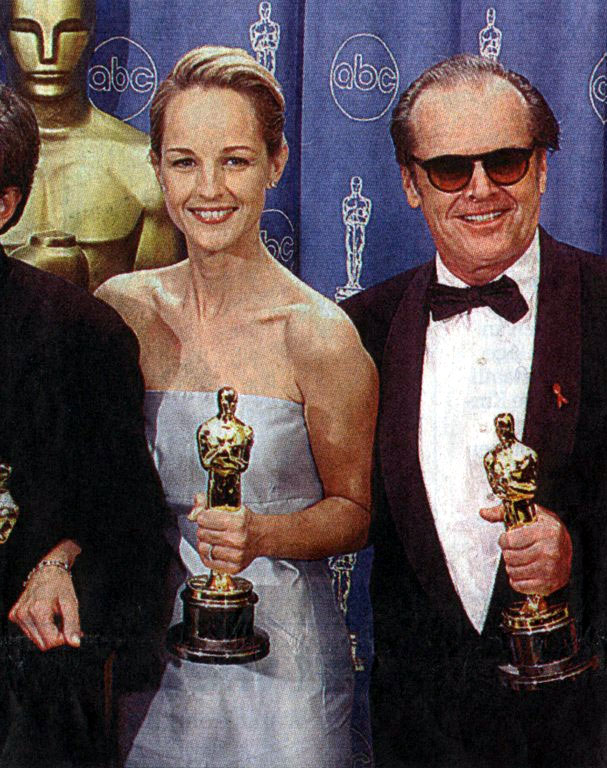
- Susan Sarandon (Dead Man Walking)
- Elisabeth Shue (Leaving Las Vegas)
- Sharon Stone (Casino)
- Meryl Streep (The Bridges of Madison County)
- Emma Thompson (Sense and Sensibility).
My issues lies within the popular choices for "Worst 'Best Actress' Winners of All Time" that I found when, after completing The Bridges of Madison County, I quickly searched the internet for such lists, to determine how high up Ms. Sarandon ranked as one of those "Worst 'Best Actresses'" - undoubtedly, thought I, she has to be at least Top 5. I was shocked and dismayed, however, to discover not only that none of the critics who have posted such rankings online have found her performance to be as lacking as I did, but also and morever that those performances that they did all seem to rank in their lists, especially their #1 choice, were among my most cherished and admired performances by leading actresses of all time - a situation that undoubtedly, I know, makes me go "WTF?!"
Basically: they all think that Helen Hunt's performance in As Good as It Gets (1997) was the worst performance to win the Best Actress Oscar of all time!! What?!!? Now, I appreciate that everyone is entitled to his or her own opinion, but seriously: did someone send out a memo that I didn't see, instructing everyone to afflict Ms. Hunt with this dubious title? Among the reasons these beraters offer up as validation of their collective criticism, the three most common/major are boredom, television, and even nationalism - am I the only one who sees the absurdity in each of these supposed reasons? Boredom: what? Seriously, what were you expecting? The film is essentially a small romantic comedy; simply because she doesn't have crashing emotional breakdowns, doesn't play a prostitute, and doesn't sing, she does not deserve the critique of being bored/boring, especially in the face of how she beautifully lightens up the screen and provides a skillful counterbalance to Mr. Nicholson's (equally neurotic but on the opposite extreme) antics. Television: what? Seriously, what does that mean? Are you trying to say that, because she was a TV actress before she was in films, she is somehow inherently lesser or in some way negatively handicapped or held at a higher standard than her film-actress peers? How would that work exactly?? And, for all of you who love Judi Dench invariably: she began on (BBC) TV too - so, suck on that. Nationalism: I'm not even going to address this one, just so ridiculous are its implications. The only sensible argument I've read in the many that have been lobbied against Ms. Hunt and her performance were that the other nominees/actresses were simply just better, and this is a claim that I can't outright refute. I can accept that the other three (Julie Christie's performance in Afterglow being the exception that I haven't seen) were all tremendous and elegant - and I do feel that, along with Julianne Moore, Kate Winslet is the most deserving actress working yet to receive an Oscar, especially after five(!) nominations of which at least 2 were simply criminal passes over her - but I have to agree with the Academy on this one and say that it was just none of their years. Ms. Winslet was elegant as always but suffered from Mr. Cameron's overly emotional bent and poor writing skills; Ms. Dench was clever but lacked what I felt was a significant investment in her character's world, where she frequently seemed to be more of Dame Judi Dench in costume than Queen Victoria in life; and Ms. Bonham Carter was both considered and emotional but lacked what I felt was a focused strength that would have otherwise grounded her role not only within the context of her character's world but also within the context of a performance general. Ms. Hunt, on the other hand, was considered, emotional, elegant, strong, clever, and invested; though it may be largely attributable to smart casting, she moved fluidly in Carol Connelly's world as though it were naturally her own and built a character that was as neurotically prepossessed of her principles and ideals yet simultaneously as endearingly earnest in her attempts to do right as was her glorious co-star's character, whose quality no one questions. So, while Ms. Hunt may not be one of my "Best 'Best Actresses' of All Time", she most certainly is not ranking in the "Worst" either.
Other botherings in the "Worst" lists of these critics, all much less unanimous than the ranking of Ms. Hunt, were Ms. Kidman in her role as Virgina Woolf in The Hours, who was an eloquent powerhouse of startling implosion and desperation and so certainly ranks among my "Best 'Best Actresses'"; Ms. Paltrow in the charming Shakespeare in Love, who was perhaps not awesome but agile in a role that demanded a lot of fluidity, both physically as a character capable of being both male and female and emotionally as a character both willfully independent and emotionally raw/naked, and whose mention is not automatically validated by the implication of a "snubbed" competitress into the argument (i. e., Cate Blanchett for her admittedly glorious turn in Elizabeth); and Ms. Holliday in the classic Born Yesterday, who was spectacular and also does not merit mention simply because of "snubbed" competition (i. e., Bette Davis in All about Eve and Gloria Swanson in Sunset Boulevard).
Now, if you want my opinion on who really were the "Worst 'Best Actresses' of All Time" - well, maybe just of the years whose nominated performances I've seen - here it is:
- Hilary Swank, Million Dollar Baby - Unextraordinary, basic, lacking depth - Should have gone to: Kate Winslet, Eternal Sunshine of the Spotless Mind
- Julia Roberts, Erin Brockovich - Unimmersed, more like Julia Roberts being herself than the character - Should have gone to: Ellen Burstyn, Requiem for a Dream
- Susan Sarandon, Dead Man Walking - (All the above reasons) - Should have gone to: Emma Thompson, Sense and Sensibility
- Charlize Theron's statuette for Monster most definitely given to Diane Keaton for Something's Gotta Give
- Halle Berry's statuette for Monster's Ball given to Nicole Kidman for Moulin Rouge
- Hilary Swank's statuette for Boys Don't Cry at least shared in a tie with Annette Bening for American Beauty
- Judy Holliday's statuette for Born Yesterday shared in a tie with Gloria Swanson for Sunset Boulevard
Signing off.
29 June 2008
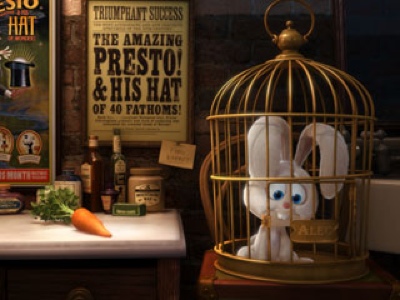
Reviews: Presto and Wall-E

22 June 2008
Another Exciting Trailer
So, this trailer is for The Curious Case of Benjamin Button, a perhaps gimmicky (despite its origins in Fitzgerald) but nevertheless beautifully cast, physically realized, and scored - thanks, Mr. Desplat! - fantasy romance set to debut this holiday season by virtue of Paramount and Warner Bros. I'm not entirely certain about the prospects for this one, but I'm going with my gut and saying that Cate couldn't make two flop choices this year in film.
Check the trailer in HD here.
:)

 Posts
Posts


