18 July 2008

Review: Mamma Mia!


Genre: Musical

Good lord, someone - anyone shut the confectionary down! I thought - no, I hoped that the goodly presence of Meryl Streep would, like it had for the fun (but still ultimately flawed) The Devil Wears Prada, enliven, enlighten, and elate the sure-to-be sugary romp of a film Mamma Mia! from its otherwise predestined den within the bottom barrels of K-Mart and Blockbuster along with all the other atrociously zippy movies produced by studios such as The Disney Channel and - well - the Disney Channel. But, no!, alas Ms. Streep, despite her many virtues (without which - to be sure - she was entirely not in this film), was no talisman against the siren-like alluring blasts of hot and cold that this film dishes up like the glitter-iest plate of french fries Hannah Montana has ever seen. And, though this review does not intend on that its words concerning the uber-pop nature of the film it discusses be a negative criticism of that uber-pop-y nature (for the film is sure to delight its millions of eager pre-teen- and teen-aged would-be fans in that respect), this review does intend on that its criticisms be an indication of the seriously deleted status of integrity, want of cohesion, and ambition to construct solid play - whatever the tone, be it comedy (musical) or drama - of the world of film, especially 'young film' (or film with a young intended audience), today. In short, it saddens me that Meryl had to sit through this bullshit. Children, enjoy.

Smiles and sparkles,
Grade: D+

P. S. Could someone, please, be good enough to inform me whether the original Broadway stage version of this show was built more solidly and coherently? For the sake of the integrity of the Tony voters, who nominated it for Best Musical in its year among other categories, I seriously hope it was.

P. P. S. If anyone should be interested in seeing a good ABBA movie, which doesn't insist on milking the pop-tastic face of ABBA until it has become a shriveled rag, he or she would do well to check out the early 90s' Muriel's Wedding, which features a great and clever turn by Toni Collette as the title character, Muriel.

P. P. P. S. - Final one, I swear - Thank you, Mr. Scott, for again so deftly filling in those words that I've felt on my tongue but been too ornery or too cursory to actually say:

"The real problem is that the director of “Mamma Mia!,” Phyllida Lloyd, seems have taken the unapologetic silliness of the project (which she directed onstage) as permission to be sloppy. Abba made some of the most highly polished, tightly engineered pop junk ever. There is a kind of perfection in some of those hits that is undeniable even if — or maybe especially if — you can’t stand to hear them. But in matters of craft and technique “Mamma Mia!” proves to be remarkably shoddy, a tangle of clumsy cuts, mismatched shots, bad lighting, egregious overdubbing and scenes in which characters appear to have been haphazardly Photoshopped into the scenery.

It is safe to say that Ms. Streep gives the worst performance of her career — safe to say because it is so clearly what she intends, and she is not an actress capable of failure. There is a degree of fascination in watching an Oscar-winning Yale School of Drama graduate mug and squirm, shimmy and shriek and generally fill every moment with antic, purposeless energy, as if she were hogging the spotlight in an eighth-grade musical.

She is saved, and also upstaged, by Ms. Walters and, especially, by Ms. Baranski, whose cougar-on-the-prowl rendition of “Does Your Mother Know” is the one genuinely, show-stoppingly sexy sequence in a film that more often flails between forced cheekiness and unearned sentiment.

I know: I promised you a good time, and I’m describing a train wreck. But it’s hard not to share the evident delight of most of the performers. Ms. Streep overdoes it, yes, but you can’t accuse her of condescending to the material any more than you can fault her for taking it too seriously."

(http://movies.nytimes.com/2008/07/18/movies/18mamm.html?8dpc)

09 July 2008

Worst "Best Supporting Actor" Winners?


For this category, it seems, Jack Palance for City Slickers and Joel Grey for Cabaret are the consensus as the "Worst 'Best Supporting Actors' of All Time." With Mr. Palance I can't disagree, but with Mr. Grey I must take issue and state (again) that the presence of a challenging and win-worthy competitor whom one may feel was "snubbed" does not alone, in and of itself, make the actual winner merit the dishonor of being titled among the "Worst 'Best'" actors ever. Only if the actual winner's performance alone, in and of itself, was clearly undeserving of the Oscar statuette for its sheer lack of quality, would the "snubbed" card possibly be admissible as supporting evidentiary support for an alternate, "should-have-been" winner. The "snubbed" card otherwise, played without such primary evidence of an actually bad performance, is merely just discontentment with the state of things; and its resultant "should-have-been" then, really merely just a personal "I-wanted-it-to-have-been." Can we all be clear on that fact?
Anyway, here are my picks for "Worst 'Best Supporting Actors'":

  • Michael Caine, The Cider House Rules - I feel like I'll probably be alone on this one, but I really just didn't see anything spectacular or outstanding about this performance; like so many others that receive recognition of some kind, it was capable and it fulfilled its task, but really for me it did only that and thus failed to show significant investment and immersion on Mr. Caine's part. It was just Mr. Caine playing the role, not Mr. Caine in the role. I think, he was much more deserving when he was nominated, for example, later for his role in or even earlier for his role in , for which he won his former statuette. This one, however, should have gone to: Jude Law, The Talented Mr. Ripley (or possibly even Tom Cruise, Magnolia).
  • Jack Palance, City Slickers - We all know why. - Should have gone to: Ben Kingsley, Bugsy
  • Don Ameche, Cocoon - He plays a old man so excited about feeling young again, that he can splash around in a pool. How awesome can an actor possibly be at splashing and smiling, that he deserves to be called the "Best Supporting Actor" of that year? I say, not very and the statuette probably should have gone to: William Hickey, Prizzi's Honor
Other amendments, which, I feel I must qualify by stating, were extremely close calls and only serve to distinguish the extremely deserving (i. e., the actual winners) from the most deserving (i. e., those who I think should have won):
  • Javier Bardem's statuette for No Country for Old Men given to Casey Affleck for The Assassination of Jesse James by the Coward Robert Ford
  • Alan Arkin's statuette for Little Miss Sunshine given to Jackie Earle Haley for Little Children
  • George Clooney's statuette for Syriana given to Jake Gyllenhaal for Brokeback Mountain
  • Morgan Freeman's statuette for Million Dollar Baby given to Clive Owen for Closer
  • Chris Cooper's statuette for Adaptation given to Christopher Walken for Catch Me If You Can
  • Jim Broadbent's statuette for Iris given to Ian McKellan for The Lord of the Rings: The Fellowship of the Ring
  • James Coburn's statuette for Affliction given to Ed Harris for The Truman Show
  • Kevin Spacey's statuette for The Ususal Suspects given to James Cromwell for Babe
  • Joe Pesci's statuette for Goodfellas given to Al Pacino for Dick Tracy
All right, next to tie up the acting categories with Supporting Actress.

Worst "Best Actor" Winners?


OK, so I was inspired by my post from last night regarding the "Worst 'Best Actress' Winners of All Time" and now am set to tackle the 'dos' and 'don'ts' of the "Worst 'Best Actor' Winners of All Time." As I haven't really had a problem with any of the recurring actors ranked as among these "Worst" on the lists of other film critics - I haven't actually seen Scent of a Woman, which seems to be the consensus for the "Worst" - I'll just dive right in to my own (with the small mention that I was shocked to see Rex Harrison for My Fair Lady on one list, since he was so thorough and distinguished in that role):

  • Jamie Foxx, Ray - O, yes, I went there and I'm standing by it: He was an impressive mimic but absolutely not an actor in that role, totally rehearsed and overly controlled so that the performance was more robotic than fluid and more submersive than immersive - Should have gone to: Leonardo DiCaprio, The Aviator
  • Roberto Benigni, Life is Beautiful - Ugghhhhhhhhhhhhh, emotionally manipulative and vacant and frankly just silly - 100% should have gone to: Ian McKellan, Gods and Monsters, who was tremendous!
  • Geoffrey Rush, Shine - A clear illustration of how blindly the Academy goes all in for any performance of a character that is in the least bit disabled/(in the words of Kate Winslet playing herself on the TV series Extras:) "mental" - Probably should have gone to: Billy Bob Thornton, Sling Blade
  • Dustin Hoffman, Rain Man - (The same reasons as those for Geoffrey Rush, which frankly are insulting to the mentally disabled and only serve to perpetuate instead of challenge their mass stereotypes) - Should have gone to: Tom Hanks, Big, which I love!
Other amendments:
  • Philip Seymour Hoffman's statuette for Capote given to Heath Ledger for Brokeback Mountain
  • Sean Penn's statuette for Mystic River given to Bill Murray for Lost in Translation
  • Tom Hanks' statuette for Philadelphia given to Anthony Hopkins for The Remains of the Day
Hmm, that wasn't as terribly exciting as I thought it might be. Well, I'll still finish up the major categories.

Worst "Best Actress" Winners?


So, I've just finished reviewing the performances that were nominated for the Best Actress Academy Award for the film year 1995:

  • Susan Sarandon (Dead Man Walking)
  • Elisabeth Shue (Leaving Las Vegas)
  • Sharon Stone (Casino)
  • Meryl Streep (The Bridges of Madison County)
  • Emma Thompson (Sense and Sensibility).
Now, Susan Sarandon won that year for her performance, opposite Sean Penn, in the weak "actors' drama" Dead Man Walking, a kind of preachy and rather simplistic morality play about right and wrong - needless to say, I wasn't very impressed - by the film as a whole as much as by Ms. Sarandon's performance, which was capable, yes, but far from wonderful and which suffered, I felt, primarily from the lack of a strong screepnlay. As I felt that way about it and as hers was only the second of the five for me to see (after Emma Thompson's, whose I cherish), I was naturally curious to complete the set and, so, I watched the outstanding three next: first, Ms. Shue: excellent; then, Ms. Stone (my predicted weak link): surprisingly strong; and, finally, Ms. Streep: wonderful, even despite the obvious flaws of the maudlin film(, but from her that's to be expected). So, needless to say, I was very confused: Why, o why, had the Academy decided to reward Ms. Sarandon, when her competitresses were not only just as deserving as, but moreover far more deserving than, she? But I chalked it up to another witlesss-Academy blunder, to another hopeless mistake of the so many that the group has made over the years, to their bizarre distribution tendency that had to just give it to her already after 4 previous winless nominations; and so, clearly, this is not where my issue lies.
My issues lies within the popular choices for "Worst 'Best Actress' Winners of All Time" that I found when, after completing The Bridges of Madison County, I quickly searched the internet for such lists, to determine how high up Ms. Sarandon ranked as one of those "Worst 'Best Actresses'" - undoubtedly, thought I, she has to be at least Top 5. I was shocked and dismayed, however, to discover not only that none of the critics who have posted such rankings online have found her performance to be as lacking as I did, but also and morever that those performances that they did all seem to rank in their lists, especially their #1 choice, were among my most cherished and admired performances by leading actresses of all time - a situation that undoubtedly, I know, makes me go "WTF?!"
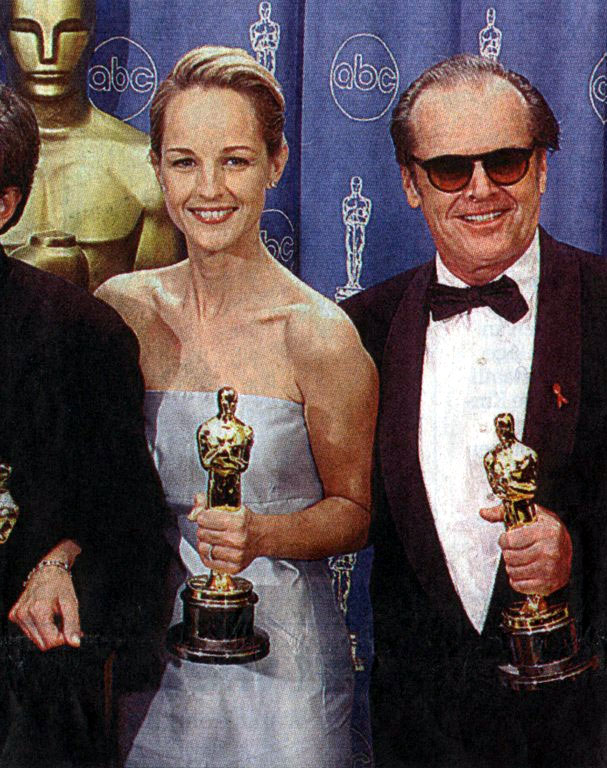
Basically: they all think that Helen Hunt's performance in As Good as It Gets (1997) was the worst performance to win the Best Actress Oscar of all time!! What?!!? Now, I appreciate that everyone is entitled to his or her own opinion, but seriously: did someone send out a memo that I didn't see, instructing everyone to afflict Ms. Hunt with this dubious title? Among the reasons these beraters offer up as validation of their collective criticism, the three most common/major are boredom, television, and even nationalism - am I the only one who sees the absurdity in each of these supposed reasons? Boredom: what? Seriously, what were you expecting? The film is essentially a small romantic comedy; simply because she doesn't have crashing emotional breakdowns, doesn't play a prostitute, and doesn't sing, she does not deserve the critique of being bored/boring, especially in the face of how she beautifully lightens up the screen and provides a skillful counterbalance to Mr. Nicholson's (equally neurotic but on the opposite extreme) antics. Television: what? Seriously, what does that mean? Are you trying to say that, because she was a TV actress before she was in films, she is somehow inherently lesser or in some way negatively handicapped or held at a higher standard than her film-actress peers? How would that work exactly?? And, for all of you who love Judi Dench invariably: she began on (BBC) TV too - so, suck on that. Nationalism: I'm not even going to address this one, just so ridiculous are its implications. The only sensible argument I've read in the many that have been lobbied against Ms. Hunt and her performance were that the other nominees/actresses were simply just better, and this is a claim that I can't outright refute. I can accept that the other three (Julie Christie's performance in Afterglow being the exception that I haven't seen) were all tremendous and elegant - and I do feel that, along with Julianne Moore, Kate Winslet is the most deserving actress working yet to receive an Oscar, especially after five(!) nominations of which at least 2 were simply criminal passes over her - but I have to agree with the Academy on this one and say that it was just none of their years. Ms. Winslet was elegant as always but suffered from Mr. Cameron's overly emotional bent and poor writing skills; Ms. Dench was clever but lacked what I felt was a significant investment in her character's world, where she frequently seemed to be more of Dame Judi Dench in costume than Queen Victoria in life; and Ms. Bonham Carter was both considered and emotional but lacked what I felt was a focused strength that would have otherwise grounded her role not only within the context of her character's world but also within the context of a performance general. Ms. Hunt, on the other hand, was considered, emotional, elegant, strong, clever, and invested; though it may be largely attributable to smart casting, she moved fluidly in Carol Connelly's world as though it were naturally her own and built a character that was as neurotically prepossessed of her principles and ideals yet simultaneously as endearingly earnest in her attempts to do right as was her glorious co-star's character, whose quality no one questions. So, while Ms. Hunt may not be one of my "Best 'Best Actresses' of All Time", she most certainly is not ranking in the "Worst" either.
Other botherings in the "Worst" lists of these critics, all much less unanimous than the ranking of Ms. Hunt, were Ms. Kidman in her role as Virgina Woolf in The Hours, who was an eloquent powerhouse of startling implosion and desperation and so certainly ranks among my "Best 'Best Actresses'"; Ms. Paltrow in the charming Shakespeare in Love, who was perhaps not awesome but agile in a role that demanded a lot of fluidity, both physically as a character capable of being both male and female and emotionally as a character both willfully independent and emotionally raw/naked, and whose mention is not automatically validated by the implication of a "snubbed" competitress into the argument (i. e., Cate Blanchett for her admittedly glorious turn in Elizabeth); and Ms. Holliday in the classic Born Yesterday, who was spectacular and also does not merit mention simply because of "snubbed" competition (i. e., Bette Davis in All about Eve and Gloria Swanson in Sunset Boulevard).
Now, if you want my opinion on who really were the "Worst 'Best Actresses' of All Time" - well, maybe just of the years whose nominated performances I've seen - here it is:
  • Hilary Swank, Million Dollar Baby - Unextraordinary, basic, lacking depth - Should have gone to: Kate Winslet, Eternal Sunshine of the Spotless Mind
  • Julia Roberts, Erin Brockovich - Unimmersed, more like Julia Roberts being herself than the character - Should have gone to: Ellen Burstyn, Requiem for a Dream
  • Susan Sarandon, Dead Man Walking - (All the above reasons) - Should have gone to: Emma Thompson, Sense and Sensibility
I will also say that a few other amendments should be made, but not that these changes mean that the women who actually won deserve the distinction of being called among the "Worst 'Best Actresses' of All Time":
  • Charlize Theron's statuette for Monster most definitely given to Diane Keaton for Something's Gotta Give
  • Halle Berry's statuette for Monster's Ball given to Nicole Kidman for Moulin Rouge
  • Hilary Swank's statuette for Boys Don't Cry at least shared in a tie with Annette Bening for American Beauty
  • Judy Holliday's statuette for Born Yesterday shared in a tie with Gloria Swanson for Sunset Boulevard
Phew, that was a lot of opining, but I'm still feeling unfulfilled. Perhaps I'll tackle "Worst 'Best Actor'" tomorrow?

Signing off.

29 June 2008

Reviews: Presto and Wall-E

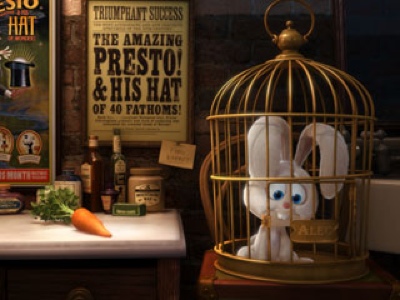
Genre: Animation Pixar's offerings from this year in film 2008 are certainly a step up from their offerings from last year, but they are certainly also not the best they are able to offer in general. While both Presto and Wall-E seem to have evolved from incredibly brilliant, ripe ideas and both are exquisitely technically executed in their animation, neither seems to have gone much past its initial conceit in a focused or well-prepared way. Comedy, born of gimmicks and slap-stickery, and a helpless vagabondery, given to bouts of wandering and turning about in circles, instead of clear and clever goals, seem to dominate the films and to break down ultimately what could have easily been the studio's best works to date. To begin with Presto, which is arguably the better of the two films for its brevity (i. e., for its self-contained status as a short film that prevents it from dragging out its supposedly comic escalations), the film relies mainly for its impact on the improv.-class-level, comedy-action dialogue between the two characters, the demanding magician and his bubbly-cute white rabbit. that doesn't really grow significantly each reprisal doesn't work. As the magician consistently denies the hungry rabbit his one desire, his large fresh carrot, the rabbit consistently thwarts the realization of the magician's one desire, the controlled awe-making of the grand theater's spectating audience. The rabbit does this to the magician by employing a series of physically comic gags mainly turning on the magical property of the magician's top hat and sorcerer's cap that as a pair allow for the teleportation of things through one and out the other. Now, I will admit, the gag is clever and, for the first few trials of it, does remain funny for the audience; but, I have to say, after escalating several times to a further level of physical humiliation for the coincidentally increasingly frustrated magician, the audience comes to expect more than just more similar escalatations. IN short, the gag after the first couple of times, like any gag, grows old. The continuous reprisals multiply, but fail to amount to anything, as the persistent multiplication of an argumentatively empty gag still leaves only emptiness (i. e., 0 x 10 still = 0). Of course, the rabbit in the end finally does get his carrot (and the magician, his adoring audience's applause) and, of course, the tormenting rabbit does come to his magician's rescue, to show that his smirking acts of cruelty weren't a manifestation of his true feelings for the magician; but then, without giving a word about why the audience should care about the events it has just witnessed - a word that would be reason for the film to bear weight beyond its status as just a slapstick-lover's dream or an adorable example of a love-hate relationship, the film ends, tyring up with its neat little Pixar bow another of the studio's increasingly less impressive animated shorts with a carefree and frankly vapid final shot. Disclaimer: While this paragraph may have seemed like a scathing negative review of the film, I must insist that it is not: In all truth, I enjoyed Presto about as much as it possibly could be enjoyed; it just chagrins me to my very core to see a studio that has produced such great shorts as Geri's Game, Knick Knack, and For the Birds fall into the creation of films that seem to be aimed at no more than mindless entertainment of the public. Grade (for Presto): B Now, for Wall-E: Wall-E is easily the most ambitious of all the Pixar films to date: Not just a simply story about a main character who dreams of experiencing something greater than himself (as consistently can be the description of each Pixar full-length release [and some of the shorts as well]), the film advances with zeal through tropes political, environmental, metaphysical, technological, and - yes - even romantic(al). While it does an admirable job at integrating all these various ambitions for an underlying message into one largely coherent screenplay, the sheer enormity that even a combination of one with another of these many ambitions into a skillful and significant screenplay would encumber on any screenwriter proves to be far too much for the film, which attempts to combine them all, and, as a result, the film, like its corpulent human characters, can barely stand on its own. The political forays that consist of several thinly veiled criticisms of the Bush administration (e. g., the repeated urgence by the film's live-action(?) President in his televised addresses that the nation should just "stay the course") and the environmental insistences that, despite the screenwriter's on-the-record denials, simply overwhelm the film with their An-Inconvenient-Truth-like messages are hard to miss by any spectator's standards. The technological partisanship for Apple, Inc. over PCs everywhere - a partisanship reinforced by the fact that the designer of the feisty attractress-robot EVE was the designer of many of the current Mac products - is probably harder for the average spectator to see on his own volition, but nonetheless vibrantly apparent to anyone made privy to that designing coincidence. The discussion and criticisms of social conventions regarding technology, the desk potato, corporation-domination, and the near-sighted techno-geek (i. e., the accustomed-to-instant-gratification Gen-Z member), brought to extreme - and frankly irrational - heights by the supposedly submerged societal fear it taps on, are - well - extreme and frankly irrational in today's increasingly health-&-fitness-minded world; they seem less contemporary and edgy than outdated and somehow that special brand of 80s-paranoid. The metaphysical conceit concerning the self and the body, strongly akin to the Cartesian theory of the body as a machine, runs largely ragged, popping up here and there regularly but inconsistently, as perhaps the strongest message of the film, but ultimately is destroyed for cheap theatrics, namely the "happy ending," in which tragedy is vaingloriously eschewed in the name of love; and - speaking of love - the romantic aspect of the film is perhaps the most contrived of all the ambitions the film sets forth, jousting for prominence, validation, and screen time: An obvious mish-mosh of celebrated (and perhaps a few uncelebrated) romantic storylines from the past, such as Titanic, The Taming of the Shrew, Beauty and the Beast, and Bicentennial Man, the romance tries to be the center-stage focus of the storyline and the struggles through which its characters must go but in the end only succeeds in trying to hard to be realized, at the severe detriment of all of the other of the film's ambitions, namely the metaphyiscal (for reasons aforementioned). In fact, considering the screenplay as a whole, the work seems to be nothing but a mash-up of popular and celebrated (and - again - some unpopular and uncelebrated) works of the past; mixing some of the more memorable scenes and suggestions from films such as One Flew over the Cuckoo's Nest, E.T.: Extra Terrestrial, BladeRunner, and 2001: A Space Odyssey in addition to the already mentioned other films (i. e., the romantic) in a way that far bypasses clever allusions and broaches on near-identical depictions, Wall-E is perhaps the most ambitious but least original piece to be penned by a filmmaker...ever. The reliance on these past films, in probable hopes to recreate their various iconic states of drama, makes the film out to be far less than what it could have been from the very start (i. e., the printed page) and seems to be a woeful handicap on the talents of the writer - sorry, Mr. Stanton - himself, in that he appears by having so written to be too unable or too uncourageous to venture out, as he implores his characters to do, and let his opus stand on its own. As I believe strongly that fatal flaws within the screenplay, the very foundation of any film, cannot ultimately be compensated for, as others may be, by excellent management of the other aspects of the film (e. g., cinematography, acting, art direction), I will not go on to comment any more on the flaws that inhere in Wall-E and demote it from its once-thought-great status to mere cinematic tomfoolery than to mention a few moments within the film that struck me as prominent and therefore worth mentioning. First, I was thrilled at first, when during the introductory scenes of the film, all was bare and sparse (i. e., beautifully constructed) and virtually silent(!) in the animated world in which Wall-E inhabits. The vacant space really began to give me the exact kind of feeling that would support a greater version of the film, one in which the sheer emptiness of Wall-E's life and world is made palpable for the audience by extensive durations of film displaying vast expanses of repetitive and unchanging soundscapes, scenery, and actions. Yet, as the first indication to me that this film lacked the guts to stand out them alone and be bold in its statement-making, this introductory period (in which Thomas Newman's beautiful score shone) was severely abridged from anywhere near the significant or impressive duration that I had hoped for. Things had to move and happen and change and explode apparently way before any sort of true impression had been instilled in the audience, imply the editors and the director, because true loneliness and exquisitely portrayed solitude is too general-audiences-unfriendly to be shown in the film. Boo for your lack of vision and boldness, Pixar. This goes for your inclusion of that forgettable, silent sidekick cockroach as well. Second (and perhaps on the other hand), Pixar, you bowled me over with your quite eery, extremely haunting, and perhaps even downright morbid display of the 'dead' Wall-E robots, scattered alongside the large highway that our main character Wall-E traverses regularly on his routine passes to and fro his home and his work. It bashed me over the head with the incredible tragedy that is that main Wall-E's life there, alone on that abandoned, barren, and aging planet and having to bear witness daily and without respite to the baking and void corpses of his fallen kin as almost manically aggressive reminders of what looks to be his incredibly forlorn and inevitable fate. O, gosh, the image, perhaps on screen for only a few instants, was so powerful, that it in itself is perhaps enough to redeem the film an entire grade point for me, and I must say, it reminded me candidly of the 'Elephant Graveyard' scenes from The Lion King in nature - an effect really neither a plus nor a minus, but more of an interesting tie-in that I was slightly disappointed was never redressed in the course of the film. Third, in any film, especially any animated film, I feel that the lead filmmaker must make, before beginning, a concrete and aboslute decision about whether or not his work will adhere to the basic and common technical, physical, and scientific principles of life in its realization; the decision must be consistent, must not flip-flop based on what seems opportune as he goes along, and must be accurately representative of the overall tenor of the film (e. g., a serious dramatic work should adhere to those principles at all times, whereas a comedy film may not). Wall-E presents itself as, if it must be categorized on such a dichotomy, the former of those two types of film, as its many ambitious messages and conceits seem to override the bouts of physical comedy that break up the film; correlatively, the film wants to adhere to the principles of physics and science etc. However, it does not; instead of consistence, it picks and chooses where and when the true results of sequences of events and of behaviors have real-world effects in its animations: While in space, Wall-E's propulsion by a fire extinguisher accurately represents the Laws of Motion but, while trying to stand up, the humans' extremely debilitated and weakened bodies do not, astoundingly, give out under the strain of their unusual exercises and tremendous weights. Aah: Be consistent, please! Do not ask us to sporadically suspend our disbelief! Finally, as is usual in most of the films I see, I must tell the cinematographer to BACK THE FUCK UP! There was such potential for exquisite wide-screen beauty in the animations in the film, but much of that potential was - again - vaingloriously squandered for maudlin close-up shots of the drama/action. Sigh. All in all, though, Wall-E wasn't the worst it could have been either. There were, like that graveyard scene, some significant redeeming qualities (that weren't special enough for me to enumerate) that brought the work up from complete catastrophe, but the case still stands: Grade: B- - For next time, Pixar and Mr. Stanton, try to accomplish less and maybe you'll succeed more.

22 June 2008

Another Exciting Trailer

So, this trailer is for The Curious Case of Benjamin Button, a perhaps gimmicky (despite its origins in Fitzgerald) but nevertheless beautifully cast, physically realized, and scored - thanks, Mr. Desplat! - fantasy romance set to debut this holiday season by virtue of Paramount and Warner Bros. I'm not entirely certain about the prospects for this one, but I'm going with my gut and saying that Cate couldn't make two flop choices this year in film.

Check the trailer in HD here.

:)

13 June 2008

Two Fun Trailers and Brief Review: Kung Fu Panda


Without any ado whatever do I present you two fun trailers that made me excited about the comic possibilities for film this year 2008:

  1. Religulous - A snappy, Bill-Maher-esque documentary on the realities of religion in the world featuring no one else than Mr. Maher himself
  2. Burn after Reading - The Coen brothers' radical little follow-up to their straight-faced No Country for Old Men produced by Focus Features(!!) and featuring a rockstar cast of everyone who matters - a clear exaggeration but I'm flowing here - and an A-game(?!) Brad Pitt - a clear statement of fact - indeed, sir, indeed.
:)

------------------------------------------------------------------------------------------------------------------
And now for Kung Fu Panda:

Genre: Animated / Comedy

Let me say, first and foremost, that Kung Fu Panda, like so many other animated summer hooks, felt sure to be a major bomb to me from the first instant when I caught its teaser trailer in front of the equally abysmal Atonement in December. A bizarre computer-generated-(CG)-animated throw-away tale about a country whose mythology and heritage these creators have surely maligned in one way or another, the film, I thought, would scarcely scratch the bottom surface of the plane of the truly, genuinely, heartily good animated fare that I've seen grace the screen, fare like 2003's The Triplettes of Belleville and Finding Nemo. Well, how blown away was I when I turned out to be...wrong?!?!
Yes, blog-readers, you read your blog correctly: I was horribly mistaken about this one, the fault of which mistake I'm attributing to the penurious bias the majority of the animated fare that is released into theaters today has infused into me. But, seriously though, a Jack-Black-led film about a Jack-Black-like panda who loves kung fu more than the guys in Office Space in whose book is an expected 'money film'?
Anyway, the point is, the film was for its type and category in a word awesome. Beautifully animated, especially during its 2-D, CG cut-out prologue (which, if you ask me, took a note or two from the exquisite closing credits sequence of 2005's Lemony Snicket's A Series of Unfortunate Events), nicely written, and sharply voiced by actors such as Dustin Hoffman and Angelina Jolie (aside from the exuberant Mr. Black himself), Kung Fu Panda was a sheer delight that had me laughing (to the utterly bewildering surprise of myself), not at it, but for it! Let me just keep it short and quick and say nothing further than Pixar and Focus Features have their work cut out for them, if they aim to better Dreamworks this year and walk away with the animation world's top honors (for their much anticipated Wall.E and 9 [and also Coraline], respectively).

Grade: B+

Stay tuned, to see what happens!

01 June 2008

Review: Sex and the City


Genre: Drama / Romance

O, I knew it all the moment when I saw that horrible tagline, "Get 'Carried' away," and - believe me when I say - rarely in my life have I ever come as close to so accurately predicting the content and the quality of a new piece as I have done this time, for this sassy and unsubstantial adaptation of the popular former television series Sex and the City.
Indeed, Sex and the City the film(2008) was, as I entirely expected (see my post on this summer's most anticipated films from early May), nothing more than a slim and transparent excuse for the familiar girls of the series to get back together one last time, to hang out and to look fabulous amidst each other and their perpetual backdrop, New York City, and do absolutely nothing else. One half vapid to the extreme and the other half chokingly maudlin, the film if it means anything only downgrades the remembered regard for the series one may have had before venturing into the theater, and to be sure it did so for me to such an extent, that I doubt now whether any respect for the series as an artwork (other than a fashion venue) was ever appropriately held...by anyone...ever. I mean, hello - did they even try to write a decent screenplay, or were banal fashion montages, overshadowed by pop hits from the 80s and today, enough for the executives, who seem to have envisioned this project as nothing more than a for-sure cash cow? And the same sentiments go for the editing and the directing of the film as well.
In fact, the only intelligence/cleverness that I did see in the playing of the film was one which I'm not even sure was done on purpose - and, if it was done on purpose, the doing was sardonic and subliminal and probably by a resentful writer who foresaw that the intended degree of substance for the film was somewhere between lace and cappuccino foam: that is, the ever-dawdling presence of the children as aside and choral-like characters, silently commenting on and criticizing the whims and the fickle, unreasoned, and often unbridled emotions of these supposedly mature and cosmopolitan women who, having endured the many tribulations that trying to find love in the city over the years has impressed upon them, nevertheless whimper and whine worse than children and continue to parade about, after only glitz and glamor, as clueless and directionless about the real matters like themselves and their own identities as they appear to be about actually finding love and making a relationship work with another person. And therein likely lies the problem.
So, that said, after ten years of watching these characters fuck up, have experiences, and then never really learn or grow (as people who have experiences do), I'm completely done with and far beyond tolerating their at this point redundant mistakes and childish drama. As far as my opinion may go, they've worse than been static: They've actively regressed; and the fact that the one interesting part in the film is the twenty-something assistant (played well by Ms. Jennifer Hudson, a surprise as the breath of fresh air in a film) who offers sound advice to the double-her-age-also-her-boss-and-yet-somehow-still-less-mature 'icon' Carrie Bradshaw, is only further confirmation of this, the level of absolute silliness that the characters as creative media have reached. I mean, how on earth is Carrie with that temper and level of emotional awareness and maturity believably supposed to be making in her reality a living being a guru on anything even close to relationships? (Really, tell me; I'd like to know.) Ugh, grow up, girls; you're celebrating a 50th birthday as we last see you and that's about 20 years late to be still just trying on the big-girl shoes. Call me again when you actually buy a pair.

Grade: Abysmal but for the fashion (which was good, Ms. Fields, but frankly you've done better [e. g., in the TV series and in The Devil Wears Prada]), a woeful D+.

P. S. As a shockingly scary afterthought: O, god, what if the film's characters are accurate depictions of the average levels of emotional, interpersonal, and intrapersonal maturities reached by adult women today? A!

P. P. S. I'm recognizing that the more I think about this film, the worse I find it really is. It wasn't even internally consistent! Carrie cheated on Aidan years ago - where was Miranda's facistically extreme vituperation and extirpation then? Shouldn't one's moral principles and coordinated reactions apply to every and all situations, not just to some based on whether or not the situation be convenient? Furthermore, Carrie fucking threw up herself the first time when she was confronted with marriage; so, how could she seriously react so strongly against Big's comparatively civil qualms and uncertainty this time around? And - best of all - the woman who knows who she is and what she wants better than anyone, Samantha throws away her incredibly healthy relationship with Smith for the completely artificial reason that she's become psychologically confused as a result of his temporarily busy schedule?!? Absurd!! I'm officially docking my grade a fraction of a point: This film now ranks a D. Let's see if I find a reason to make it go any lower.

09 May 2008

Review: Speed Racer


Genre: Action / Drama

O, Speed Racer. Streaming with lights and colors the equivalent of the {pop} of a little girl's juicy pink bubblegum and cracking its turns in just as sharp a manner, Speed Racer is easily categorized within the Red-Bull-lined walls of hall of the summer blockbusters. Its archetypical "good v. evil" plotline, fueled by high-octane - o, forgive me the automotive word-play - visual effects, is sure to delight any movie-goer who seeks only the blast-and-thrill of a harrowing ride through treacherous but ultimately surmountable terrain. Predictable down to its very core and fashioned together in a rather rapturous, rather than intelligent way, the film fails to be - well - it fails to be...anything other than what it ought to be. (Take a moment here to pause, if need be.) Seriously, people, why ought we automatically switch to 'decry mode' when a film like Speed Racer decides not to present us with a perspective that is novel or in any way subversive of the notions we had of it before its theatrical release? Is there something so inherently wrong with the good, old-fashioned summer blockbuster that fruit cannot be redeemed from its frame? I heartily stand by the answer "no" (to that second question). Speed Racer in my opinion accomplishes exactly what it set out to accomplish: a colorful and attractive revitalization in pop culture of a lore that has lain dormant since the end of its childhood hey-days back in the late 1960s - early 1970s - for that is exactly what Speed Racer is, a franchise mostly unplumbed and unknown by the masses of today's society. To offer up anything else would have been a consciously esoteric mettle, toward disregarding the majority of the film's potential audience - because, really, how many people can raise their hands today and then dutifully recite everything about the Speed Racer chronicles, how many especially from the generations of people born after the franchise's original hey-day? No, to offer up a different glimpse into Speed Racer would have been a mistake; as always, context must be first provided, in order to set the stage for a grounded and non-partisan debate about the more profound reaches of a matter. So, I applaud Speed Racer for this its orientation and all the more for the juicy plums and pears and apples and lemons with which it was able to paint its new adaptation, fruits that place it high as the bar for this 2008 summer season.

Now for the good stuff: Indeed, the makers of Speed Racer were able to find remarkable riches within their project that lifted the film out of its tried and tired categorization and deftly and jauntily placed it on the truly admirable level. The colors and contrasts that burst with all the exciting "Eek!" of pop art are truly beautiful decorations of the story and perhaps one of the two highlight-features of the film. They immediately nod to the high-energy and rapid, racing-directed focus of the plot as well as pay homage in their artful combinations to the era that bore them in origin, while simultaneously they amp up to date that original color palette and signal the planar situation of the reality within the film as somewhere beyond dreams (and perhaps adjacent to Roald Dahl's Wonka-land). Nowhere else could the phrase "Holy cannoli, Speed!" be uttered in seriousness and not receive an obligatory eye-roll or chuckle in response. They work well as a conceit too, for they epitomize the clash of the gaudy and immoderate and the wholesome and true in a way that is fantastically engaging; for they progress from blending and flowing and generally dazzling in the early stages of the plot, when it is difficult to parse the good from the bad, to astutely discriminating certain character sets and atmospheres from certain others in the later stages, when the natures of things are clear. As Speed and his team buzz with the sleek and rich combinations of navy blues with sunshine yellows, cherry reds with ripe oranges, and crisp whites with oil blacks without blowing out, the underhanded evil-doers reek in vomiticious combinations of sour apple with brick orange, garish gold with peacock purple, and thick turquoise with mud brown. I haven't seen such a good use of stylized, super-saturated color since another latent comic-book adaptation took to the screen: 1992's Dick Tracy (which coincidentally took home the Oscar for Art Direction that year - ahem). And of course the races would be nothing without them.
Speaking of the races: They were another great unexpected feature of the film. They were wonderfully choreographed and read much more like passionate dances than NASCAR trials. I suppose, this elegant choreography could be attributed to high-art ambition of the film-makers who were not so shy enough to prominently display within the dialogue of the film said ambition toward being more than just fast and loose imagery (see Susan Sarandon's Mrs. Racer's private conversation with Speed), but I'm not above appreciating the quality of something that is true quality, even if it be presented heavy-handedly in context. The flips and jumps, twists and turns, especially when performed in series on one of those narrow curves, were wonderful absolutely.
However, not everything about the film was wonderful; this is not a gushingly positive review after all. Among those things I found fault with were most prominently the cinematography, the introduction, and the directorial choices about certain things. Taking them in that order: I found the distance and the framing of the cinematography to be incredibly off. Why must everything be inspected so freaking closely all the time, Mr. Tattersall? It is a terribly one-sided move on your part and denies the spectator any real chance to orient himself within the new spaces we encounter, for even your so-called "establishment shots" are frequently crunched up from one side of side of the frame and incomplete. I found myself mentally shouting, "Pull back!", a lot while watching as well as "Be still!" during the non-racing scenes. It would have been nice to give your viewers those breaks from the constantly roving camera and - not only that but - it would have been smart to give your camera the same contrasts in motion and range as you and the art directors did in color and light, especially within this movie so hitting on sharp contrasts. However, I must commend you, Mr. Tattersall; at least your lighting and your angles, which were often soft and flat respectively, did aid the 2-D over 3-D composite feel that the film did (brilliantly) display (interpolating direct references to manga, comics, and the original Speed Racer among the contemporary effects while simultaneously sticking to the conceits of fantasy and high contrast throughout). But really, check your framings; your odd croppings did not go unnoticed either.
In fact, the introduction (i. e., about the first 7 or 8 minutes) was marred by your bizarre clippings as well as by other things - namely, the editing and the acting. Spliced too close together, such that the jumps were jerky and the actors practically stepping on each other's lines, that introductory period, which is designed to graciously induct the audience into the world of the film, was more like a series of sharp jabs to the face than a gracious induction. Fortunately that quality went away, but no one likes a sloppy, uncomfortable, and jittery start - especially not Speed. It leaves one feeling dizzy and rather like the other party was trying too hard.
The responsibility for this factor lies in no hands other than the directors'. The Wachowski brothers were able to keep their hands on this boiler-maker for the most part with a minimum of awkward hiccoughs, but there was a significant couple. That introduction was one; the switch-off during the Casa Cristo race was the other. Being unable to get Christina Ricci to really deliver during this her most active scene during the movie was the least of it. While the fight was happily choreographed and buzzed along as usual, the end results of it, the posture and the possession of the weapons, was something different altogether. Bear in mind, please, that this film is (as was said) a happy and non-subversive revitalization of a childhood-geared comic-book series! Do not give the firearms to Speed Racer and his team, the wholesome image of morality and decency!! It is soooo not in keeping with the message or the tenor of the entire Speed Racer franchise. It is just disturbing - jarring even - and cacaphonously dissonant from the flow of what they, the Racers, purport to be all about. People who say things like "Holy cannoli!" and "Jiminy!" have no business brandishing pistols and machine guns at their enemies. It's just not cool. (That said, I feel like I should address here the "shit" uttered by Speed during the Grand Prix, finale race. A far cry from issues like mortality and homicide [which subjects in a film that has its wiped-out racecar drivers whisked safely off of the course in a protective bubble are foreign matters anyway], one small instance of verbal 'impurity' on the behalf of the wholesome Racers is not going to crumble the keystone of their collective character. In fact, if used appropriately [as it was], it can become symbolic in this updating adaptation of their breaking away both from the clutches of Speed's greedy competitors and from the constraints imposed upon them by the reckonings and expectations of our society [i. e., from their original shoe-polish-shiny source material]. In other words, it gave them a non-calamitous edge at an instant when it was really sharp to do so. So, directors, take note: one "shit" = good, multiple loaded weapons in the hands of our model heroes = bad.)
In any case - putting aside these needling comments about morality - the film was a surprising success for me, a success I feel that can mostly be attributed to its other highlight-feature: Michael Giacchino's brilliant(!) score. Mr. Giacchino's music, made well-known in this bang-prone milieu of cartoons and cartoon adaptations (e. g., The Incredibles, Ratatouille), works fabulously well as the vroom behind Emile Hirsche's engines. Spiking and cascading at exactly the right moments and just generally placing a huge, positive bang! at the end of every major phrase, whatever the tenor, the score was the standout point of the film. I would not be surprised if its excellent work went out to garner more official acclaim at the end of this 2008 year in film. It was truly spectacular.
And, because I can't not address him, Mr. Hirsche was a sheer classic too. A great decision to expand himself, now off his Into the Wild success; he was the perfect man to step into Speed Racer's signature white jacket and visor. Good work (and great clothes).
Go, Speed Racer, go!

Grade: A solid B.

05 May 2008

Summer 2008


Wow; so, I've just taken in the long list of summer fare that awaits us for this year in film 2008 and, I have to say, things are looking better than ever. Not only are we to be treated to films the likes of which seem distant in our memories (e. g., Wall-E, Brideshead Revisited), but we are also lined up for the more mainstream films (i. e., the summer blockbusters) that this year have forgone the exclusively special-effects driven route of years past and actually garnered themselves quite impressive casts and hopefully therefore similarly impressive screenplays (e. g., Mamma Mia, Speed Racer, The Hulk). Of course, there are the few rotten-looking apples in the bushel - ahem, The Chronicles of Narnia: Prince Caspian, ahem - but as with any summer stock the heat is bound to addle one or two in the bunch and these minorities are acceptable losses. So, without anymore aplomb or ado, here is my brief list about the films that I'm excited to see this summer 2008:

  1. Iron Man (2 May) - Robert Downey, Jr., bringing back that "Kiss Kiss, Bang Bang" sardonic wit-bravado - only this time with eye-candy techno-toys - there's nothing more to say. (All right, Terence Howard, Gwenyth Paltrow, and Jeff Bridges are pluses too.)
  2. Speed Racer (9 May) - A blown-out, no-stops, FX-driven movie for sure, but with Emile Hirsche at the wheel (i. e., our Best Actor from 2007) and a somehow catchingly quirky supporting ensemble of Susan Sarandon, John Goodman, and Christina Ricci I say that this chariot is going to give a much sharper ride.
  3. Indiana Jones and the Temple of the Crystal Skull (22 May) - Sure, the Jones franchise has been dormant for the last - er - several years and, sure, our leading man Mr. Ford has eclipsed into full-on senior-citizen status (i. e., he's 65); but Cate Blanchett in that fabulous jet-black bob says, "Shut the fuck up; it's going to be awesome." Here's to hoping she's right.
  4. Sex and the City (30 May) - OK, so I'm not going to make any excuse for the extremely "Gag-me/Did-they-even-try-writing?/This-is-all-so-predictable" apparent nature of this, the most stylized, film of the summer career (mostly because it is blatantly clear that there is none and they basically made this film so that the girls could hang out together and look pretty one more time [or so that the Zeitgeist of girls in the real world will not come to a crashing demise after four-years without their elect quartet of models for behavior]) - whichever - but I will say that it is sure to be entertaining for at least that quality/reason. The glitter and glamour that was the iconograph of the SATC franchise is there in full flush and Ms. Fields may be looking at another potential Oscar nomination. (Too early to call?)
  5. The Incredible Hulk (13 June) - Edward Norton is a class-A actor who knows how to pick his scripts. His being on board, especially in the leading role, as well as Mr. Hurt's involvement look to solidify this FX-pic into at least an Iron-Man level of quality (which gets a B from me by the way).
  6. Wall-E (27 June) - Pixar sets itself up for another major hit, both critically and popularly, with this innovative storyline about a rather Zen, little robot. The trailer at once put me in mind of the greatness that was the studio's last amazing project Finding Nemo - a huge plus, since I was less than thrilled by the interstitial films between then and now - and, moreover, it put me in mind of that Walt Whitman poem "A Noiseless Patient Spider" (from his Leaves of Grass [1900]) which is an endlessly more promising link. Any inspired connection like that one immediately sets my mind on the greatness track. (I wonder if the Pixar people were actually jumped off from that work. Anyone?)
  7. The Wackness (3 July) - Admittedly probably the least solid of all these films, but Ben Kingsley and Mary-Kate Olsen in a performance that the Times has already called one of the summer's best (Durbin, http://www.nytimes.com/interactive/2008/05/04/movies/20080504_DURBIN_FEATURE.html) could tip the scales in this boutique film's favor.
  8. The Dark Knight (18 July) - Christian Bale, Maggie Gyllenhaal, Aaron Eckhart, Michael Caine, Morgan Freeman, and Heath Ledger do not just sign onto a project together because they think it may be cool to hang out, especially when Mr. Ledger is stepping into Jack Nicholson's very weighty shoes. No, they mean business; the Batman is back and is looking quite thrilling.
  9. Mamma Mia (18 July) - Meryl Streep, similarly to the The Dark Knight's cast, does not just join a project on a whim. She has to see the potential in it, despite whatever maternal impeti she may have to provide fine family entertainment for her daughter - um, that means you, Ms. Kidman. I mean, Ms. Streep rocked that otherwise fluffy The Devil Wears Prada two years ago, when it was in a very similar spot to where Mamma Mia now finds itself: the bubbly, fun-loving adaptation niche of the summer spectrum, a position more recently held by a one Hairspray; and so who is to say she hasn't done it again? Like its predecessors, Mamma Mia looks like it will at least be a well-acted, decently done sensation of entertainment.
  10. Brideshead Revisited (July) - Another new-century Waugh adaptation - huzzah! I'm incredibly excited by this one - for several reasons, namely the president presence of the great Emma Thompson, the smart source-material that is the Waugh text, and the swift and becoming featuring of Matthew Goode (of Match Point fame) in the leading role. I can't wait to touch this one! I'm predicting it will be at least as enjoyable as was 2003's Bright Young Things (taken off Vile Bodies).
  11. The House Bunny (22 August) - And, semi-limping in as this list's only late summer entry, this easy farce of a film has one significant redeeming feature: the comic brilliance that can be Anna Faris. A beautiful addition to the casts of such A+ films as Lost in Translation and Brokeback Mountain, Ms. Faris here delivers up one of her probably less significant pieces but nonetheless seems to shine in that quirky but endearing and captivating way that made her the staple of the Scary Movie franchise. And, because it must be repeated as it was said quite deftly by Manohla Dargis of the Times in her recent article "Is There a Real Woman in This Multiplex?" (http://www.nytimes.com/2008/05/04/movies/moviesspecial/04dargi.html), Ms. Faris who "tends to do the dumb-blonde thing with sizable quotation marks [...] could [very well] be the next Judy Holliday [... with] the right material." So, look out for this film; it could surprise you as well as me.
Cheers, film-goers. I'll be with you throughout this season 2008.